VPS 4GB
Start small with reliable VPS performance.
Special PriceSave 50%
Renews at $19.99/month
Core Resources
- 2 vCPU
- 4 GB RAM
- 80 GB SSD Storage
- Unmetered Transfer
Deploy Now
30-day money back guarantee!


Gogs VPS Docker Hosting
Run your own painless Git service on a GreenGeeks VPS. Gogs is a single Go binary that stays light, while a separate PostgreSQL database keeps repositories, issues, and pull requests fast as the team grows.





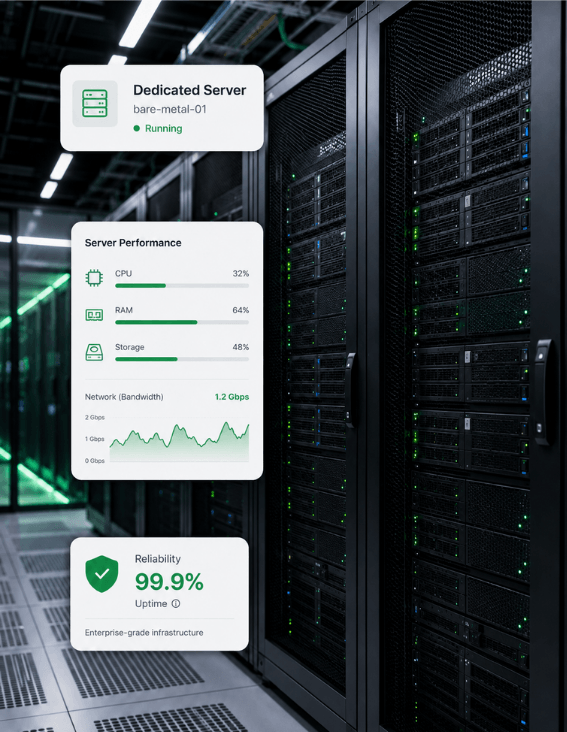
A team Git service needs reliable CPU, RAM headroom for clones and CI pulls, and a fast database alongside, and a GreenGeeks VPS provides all three under 99.9% uptime.
Clones, pushes, and CI pulls spike CPU and memory, and a VPS gives reserved resources so Git stays quick for the whole team.
Issues, pull requests, and metadata live in the database, and SSD-backed Postgres keeps that fast well past what SQLite handles.
Your Git server is where the team's work lives, and 99.9% uptime plus 24/7 support keeps it reachable every working hour.
Git over SSH, NGINX TLS, and custom ports need root, and a VPS gives that with full config freedom.
Full root access, guaranteed resources, and unmetered transfer — you take control.
Start small with reliable VPS performance.
Renews at $19.99/month
Core Resources
30-day money back guarantee!
Scale up apps, databases, and containers.
Renews at $39.99/month
Core Resources
30-day money back guarantee!
Run production workloads with more resources.
Renews at $79.99/month
Core Resources
30-day money back guarantee!
High-capacity VPS for demanding applications.
Renews at $109.99/month
Core Resources
30-day money back guarantee!
Gogs, short for Go Git Service, has been built since 2014 as a painless, self-hosted Git service that ships as a single cross-platform binary written in Go. The project is released under the MIT license and is free for any use. Its whole goal is to make setting up a private Git server as simple and as light as possible, which is why it runs comfortably on hardware as small as a Raspberry Pi.
Gogs serves its web UI on port 3000 by default and includes a built-in SSH server for Git over SSH alongside the option to use the host's OpenSSH. It stores repositories on disk and keeps issues, pull requests, users, and organizations in a database. SQLite is the zero-config default, while PostgreSQL or MySQL is the right choice once more than a handful of users share the server.
Teams use Gogs as a private GitHub replacement they fully control. It covers repository management with public, private, and mirrored repos, issue tracking with labels and milestones, pull requests with code review, a per-repo wiki, and an in-browser file editor, so a small team gets the core collaboration workflow without standing up anything as heavy as GitLab.
Beyond day-to-day Git, Gogs supports organizations and teams with per-team access control, webhooks to trigger CI and deploy pipelines, Git hooks, repository mirroring to and from other hosts, and authentication through built-in accounts, LDAP, SMTP, PAM, or OAuth. The single-binary design means upgrades are usually a binary swap and a restart.

Gogs supports SQLite3, PostgreSQL, MySQL, TiDB, and MSSQL as its backing database, so you can start on SQLite and move to Postgres without changing the application. Repositories live on the filesystem while the database holds the collaboration metadata, and the whole service is one binary plus a config file, which makes backups and migrations straightforward.
On the access side, Gogs offers two-factor authentication, per-repository and per-organization permissions, deploy keys, and access tokens for API and CI use. It is normally served behind an HTTPS reverse proxy such as NGINX that terminates TLS in front of port 3000, while Git over SSH is exposed either through the built-in SSH server or the host's sshd.
Everything you need to know about self-hosting Gogs on GreenGeeks VPS.
Gogs (Go Git Service) is a painless, self-hosted Git service that ships as a single cross-platform binary written in Go. It gives a team a private GitHub-style server with repository management, issue tracking, pull requests with code review, a per-repo wiki, an in-browser editor, organizations and teams, webhooks, and repository mirroring. Its design goal is to be as simple and lightweight to run as possible, so it works on everything from a Raspberry Pi to a production VPS.
Gogs is famously light on resources. A small instance runs comfortably on a single CPU core and around 512 MB of RAM, and the project is well known for running on low-power hardware such as a Raspberry Pi. Resource use scales mainly with the number of users, the volume of concurrent Git operations like clones and CI pulls, and the database backend rather than with the raw number of repositories stored on disk.
Gogs serves its web UI on TCP port 3000 by default and handles Git over SSH on port 22 through either its built-in SSH server or the host's OpenSSH daemon. Production deployments place an HTTPS-terminating reverse proxy such as NGINX in front of port 3000, with TLS certificates from Let's Encrypt and the upstream pointing at 127.0.0.1:3000 on loopback, while SSH access is exposed on 22 or a custom port.
Gogs needs very little RAM. A personal or small-team instance runs comfortably in 512 MB or less, which is why it is a popular choice for low-power and home-lab hardware. A busier team server with frequent concurrent clones, CI pulls, and a PostgreSQL backend is happy with 1 to 2 GB of RAM, and the figure scales with concurrent Git activity and user count rather than with the number of repositories.
Gogs ships a built-in backup command (gogs backup) that bundles the database, configuration, and repository data into an archive for restore on a clean server. You can also back up the pieces directly: dump the PostgreSQL or MySQL database (or copy the SQLite file), copy the repository directory on disk, and save the app.ini config and custom directory. Because Gogs keeps repositories on the filesystem and metadata in the database, preserving both is all that is needed to rebuild an instance.
Yes. Gogs is fully free and open source under the MIT license, with no paid tiers, seat fees, or capacity limits for any use, commercial or personal. The entire product is the open-source binary, so self-hosting it on your own VPS gives you the complete feature set without any license cost.
Gogs supports SQLite3, PostgreSQL, MySQL, TiDB, and MSSQL as its backing database. SQLite is the zero-configuration default and is fine for personal use or a very small team, while PostgreSQL (or MySQL) is the recommended choice once more than a handful of users share the server, because it handles concurrent access to issues, pull requests, and metadata far better than a single SQLite file.
Two install paths are common. Run the official gogs/gogs Docker image with the web port mapped to 3000 and the SSH port mapped to 22 or 2222, mounting a /data volume for repositories and config, or download the single Gogs binary for your platform and run it directly with a service manager such as systemd. In either case, point Gogs at a PostgreSQL or MySQL database during the first-run web installer once you expect more than a couple of users.
Yes. PostgreSQL is one of the supported database backends for Gogs, alongside SQLite3, MySQL, TiDB, and MSSQL. PostgreSQL is the recommended choice for any deployment beyond a single user or a tiny team, because it handles concurrent reads and writes to issues, pull requests, users, and organization metadata much better than the default SQLite file, and an SSD-backed Postgres keeps the service responsive as repositories and activity grow.
Gitea is a community fork of Gogs that started in 2016 when contributors wanted faster, more open development. Both share the same Go single-binary, lightweight self-hosted Git heritage, but Gitea has since added a larger feature set, a faster release cadence, and a bigger community, while Gogs deliberately stays minimal and focused on simplicity. Gogs remains an excellent choice when you want the lightest possible self-hosted Git server with a small, stable footprint.
Run self-hosted Gogs on GreenGeeks VPS hosting — dedicated CPU and RAM for Git operations, SSD-backed PostgreSQL for repositories at scale, root access for SSH and reverse-proxy tuning, and 99.9% uptime for your team's Git service, all on 300% renewable-powered servers.
Dedicated CPU and RAM keep clones, pushes, and CI pulls fast for the team.
SSD-backed PostgreSQL handles repositories and activity far past SQLite.
Root access for Git over SSH, NGINX TLS, and custom port config.
300% renewable energy match on every VPS.