VPS 4GB
Start small with reliable VPS performance.
Special PriceSave 50%
Renews at $19.99/month
Core Resources
- 2 vCPU
- 4 GB RAM
- 80 GB SSD Storage
- Unmetered Transfer
Deploy Now
30-day money back guarantee!


Home Assistant VPS Docker Hosting
Home Assistant usually runs on a local Raspberry Pi, but a GreenGeeks VPS suits cloud-API setups, remote dashboards, and multi-site automation work.





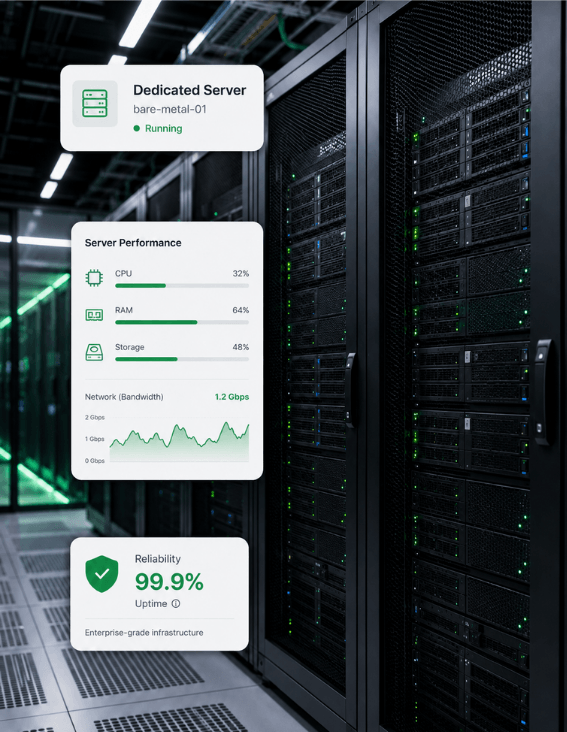
GreenGeeks gives a remote Home Assistant 24/7 uptime for cloud-API devices, RAM for the Recorder, fast SSD, nightly backups, and renewable-matched servers.
A 24/7 uptime target keeps automations on cloud-API devices firing without gaps in daily routines.
Generous RAM lets the Recorder DB hold state changes and history queries without thrashing the swap.
Fast SSD storage cuts I/O lag for Recorder writes, so dashboards and the Logbook load fast in use.
Nightly backups capture the config directory, so a broken update never wipes long-built automations.
Full root access, guaranteed resources, and unmetered transfer — you take control.
Start small with reliable VPS performance.
Renews at $19.99/month
Core Resources
30-day money back guarantee!
Scale up apps, databases, and containers.
Renews at $39.99/month
Core Resources
30-day money back guarantee!
Run production workloads with more resources.
Renews at $79.99/month
Core Resources
30-day money back guarantee!
High-capacity VPS for demanding applications.
Renews at $109.99/month
Core Resources
30-day money back guarantee!
Home Assistant is free, open-source smart home software that unifies lights, thermostats, cameras, locks, sensors, and switches into a single dashboard with an automation engine. The project is owned and governed by the non-profit Open Home Foundation, which also stewards ESPHome, Music Assistant, HACS, and Piper among more than 250 related open-source projects, with privacy, choice, and sustainability as its stated principles.
Most installs run on a small local device, since local-protocol devices over Zigbee, Z-Wave, Matter, and Thread need a coordinator on the same network. Home Assistant Green, Home Assistant Yellow, a Raspberry Pi, or a mini-PC are the conventional hosts. Active installations passed 600,000 during 2026 per anonymous analytics.
You can use a remote Home Assistant on a VPS to centralize cloud-API devices such as smart plugs, video doorbells, Wi-Fi thermostats, and any vendor that exposes a public REST or MQTT endpoint. The hub then drives notifications, schedules, presence routines, and energy dashboards across that fleet, without needing a local radio coordinator to be in range of the server hardware.
Beyond a single household, a VPS install fits the multi-site aggregation case, where one operator monitors several rental units, vacation homes, or remote offices through their cloud APIs. Pairing this with a small local Zigbee2MQTT bridge per site, connected over MQTT, lets the radio devices stay close to their hardware while the central Home Assistant view stays remote.
Home Assistant ships more than 1,000 official integrations and supports more than 3,000 named devices over Wi-Fi, Zigbee, Z-Wave, Bluetooth, Thread, and Matter, all surfaced through one dashboard. The 2026.1 release promoted Matter and Thread into the primary Settings menu, alongside the new section-based Home Dashboard and Quick Search.
Automations can be written in the visual editor, in YAML, or through community Blueprints, with Node-RED available as an external option for complex flows. The Recorder integration persists every state change to SQLite by default, with MariaDB or PostgreSQL recommended for larger installs. The ESPHome firmware project lets ESP32 boards act as RF proxies and bidirectional sensors.
Everything you need to know about self-hosting Home Assistant on GreenGeeks VPS.
Home Assistant is free, open-source smart home software that unifies lights, thermostats, cameras, locks, sensors, and switches into a single local hub with an automation engine. It is governed by the Open Home Foundation, a non-profit announced in April 2024 that also stewards ESPHome, Music Assistant, HACS, and more than 250 related open-source projects. The platform supports thousands of integrations and runs entirely on hardware you control, with the option of paid cloud access for remote use across the wider internet.
Home Assistant controls thousands of smart devices from one dashboard. You can build automations around sunset lighting, presence-based heating, leak alerts, garage door reminders, and notification routines triggered by sensors or by external events. The Energy dashboard tracks solar generation, grid use, and per-device consumption. Voice control runs through the built-in Assist feature on supported hardware. The Logbook records every event, and history graphs show state changes for every entity, which makes diagnosing a misbehaving automation easier on a busy hub.
Home Assistant ships more than 1,000 official integrations, covering more than 3,000 named devices across major smart-home brands and open protocols. Categories range from lighting and climate to cameras, locks, energy monitors, presence sensors, weather services, voice assistants, and home appliances. The community add-on store, HACS, layers many more community integrations on top of the official catalog. The breadth is one of the main reasons people pick Home Assistant over vendor-specific hubs that only talk to one ecosystem of devices on the market.
Home Assistant OS is the turnkey image that includes the Supervisor, the official Add-on Store, and one-click upgrades. Home Assistant Container is the Docker image that omits the Supervisor and the Add-on Store, so services like MQTT brokers, Node-RED, AdGuard, and Zigbee2MQTT must be deployed as separate containers that the operator manages. Container fits servers that already run Docker. OS fits dedicated hardware. The Supervised path has been deprecated for new installs since May 2025 by the project maintainers in the docs.
Yes, technically, though it is an advanced configuration. A VPS fits cloud-API and Wi-Fi devices because those talk over HTTPS rather than over local radios. Local radio devices over Zigbee or Z-Wave need a coordinator on the same LAN as the devices, so the practical pattern is to keep a small local box at home running Zigbee2MQTT and bridge it to the remote Home Assistant over MQTT. Most homes stay on local hardware specifically to avoid this hybrid setup workflow.
Yes, the core platform is free and open source with no paywalled features. There is no per-device fee, no per-user fee, and no time limit on use. The optional Nabu Casa Cloud subscription, priced at roughly $6.50 to $8 per month, funds the project and adds simple encrypted remote access along with turn-key Alexa and Google Assistant integration. A 30-day trial is offered to new users. Self-hosting remote access through a reverse proxy or VPN remains fully supported for users who prefer not to subscribe.
A Python application runs on local hardware or on a server, talks to devices through more than 1,000 integrations over Wi-Fi, Zigbee, Z-Wave, Bluetooth, Thread, and Matter, and stores state in a recorder database. A rule engine executes user-defined automations on triggers, conditions, and actions. Local-protocol radios need a coordinator on the same LAN as the devices. Cloud-API integrations talk to vendor endpoints over HTTPS. The Companion mobile apps expose phone sensors back to the hub for location-aware routines on the go.
Yes. Local-protocol devices over Zigbee, Z-Wave, Matter, Thread, and ESPHome continue to work during an internet outage, since they talk directly to a coordinator on the local network rather than to a vendor cloud. Only integrations that depend on a vendor cloud endpoint, such as a cloud-based thermostat with no local API, break during an outage. This local-first design is one of the main reasons people pick the platform, since smart-home rules keep firing even when the outside link is down.
The minimum target is two CPU cores, two gigabytes of RAM, and persistent storage on the host. The community recommends a modern CPU with four to eight gigabytes of RAM and at least 32 gigabytes of fast storage for an installation that scales as you add integrations and history. Idle RAM use sits around 300 to 500 megabytes. Larger installs that record many sensors at high frequency benefit from migrating the Recorder database from SQLite to MariaDB or PostgreSQL for better concurrent throughput.
No. A Raspberry Pi is one common entry path, but Home Assistant runs on Home Assistant Green and Yellow appliances, mini-PCs, NAS units, virtual machines, and any Docker host that meets the resource targets. Larger installs typically move off the Pi to a mini-PC or VM for more headroom, faster storage, and better concurrent performance under the Recorder workload. Pi-class hardware on an SD card is also where the long-running SD-card wear problem shows up, which an external SSD generally solves.
Run self-hosted Home Assistant on GreenGeeks VPS hosting — 24/7 uptime for cloud automations, RAM for the Recorder database, nightly config backups, and 24/7 support, all on 300% renewable-powered servers.
24/7 uptime so cloud automations and schedules never miss.
RAM headroom for the Recorder database and history queries.
Nightly backups of the config directory and automations.
300% renewable energy match on every VPS.