VPS 4GB
Start small with reliable VPS performance.
Special PriceSave 50%
Renews at $19.99/month
Core Resources
- 2 vCPU
- 4 GB RAM
- 80 GB SSD Storage
- Unmetered Transfer
Deploy Now
30-day money back guarantee!


MinIO VPS Docker Hosting
Replace AWS S3 bills with self-hosted MinIO on a GreenGeeks VPS that turns per-gigabyte storage and egress costs into one flat monthly server bill.





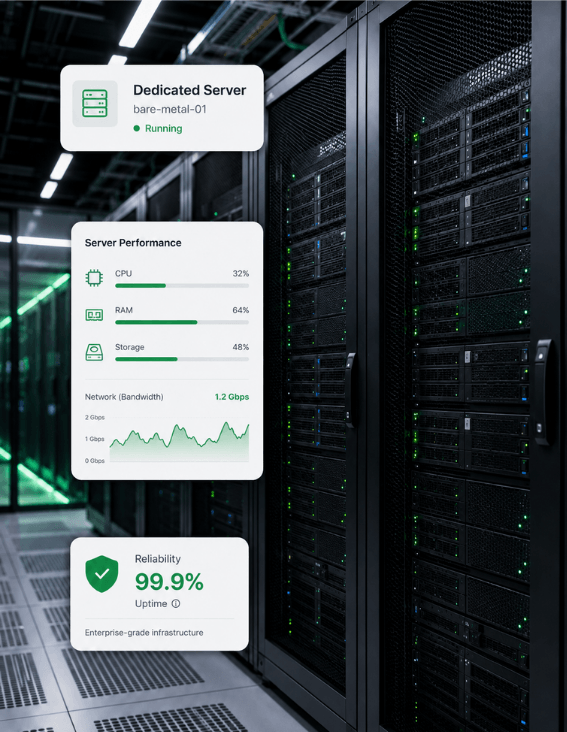
Object storage is network-bound and IO-sensitive, so a VPS with steady CPU, fast SSDs, and sustained bandwidth on green servers is the practical pick.
Small-file PUTs hammer disk IO, and SSD storage on every VPS plan keeps PUT and GET latency steady.
Concurrent S3 calls eat CPU and RAM, so a VPS keeps both yours without noisy neighbor steal.
MinIO is network-bound, and unmetered datacenter networking carries PUT and GET throughput at scale.
Flat VPS pricing replaces per-gigabyte storage costs and per-gigabyte S3 egress charges from clouds.
Full root access, guaranteed resources, and unmetered transfer — you take control.
Start small with reliable VPS performance.
Renews at $19.99/month
Core Resources
30-day money back guarantee!
Scale up apps, databases, and containers.
Renews at $39.99/month
Core Resources
30-day money back guarantee!
Run production workloads with more resources.
Renews at $79.99/month
Core Resources
30-day money back guarantee!
High-capacity VPS for demanding applications.
Renews at $109.99/month
Core Resources
30-day money back guarantee!
MinIO is a high-performance, S3-compatible object storage server written in Go. A single binary listens on port 9000 for the S3 API and on 9001 for the web console, which is why so many self-hosters reach for it as the drop-in S3 endpoint for application uploads, backups, log archives, and AI/ML data lakes on their own hardware.
License and project status matter here. MinIO moved from Apache 2.0 to AGPLv3 in 2025, the Community Edition entered maintenance mode in December 2025, and the public repo was archived in April 2026. Existing deployments still run, and many self-hosters pin to a release made before the admin-UI rip-out.
A MinIO endpoint works as a private S3 for application uploads, image storage for a CMS, Velero backup target for Kubernetes clusters, log archive behind Grafana Loki, artifact store for CI/CD pipelines, and dataset bucket for AI and ML pipelines feeding Jupyter or training jobs. Velero needs s3ForcePathStyle set to true, and Loki needs s3forcepathstyle in its config.
The wider appeal is cost framing. AWS S3 charges $0.023 per GB per month for standard storage plus $0.09 per GB egress out, and replacing both with flat VPS pricing reduces total cost for backup and log workloads where the data is large but rarely read.

MinIO covers the S3 API surface with server-side encryption via SSE-KMS, bucket versioning, object locking and WORM, bucket and site replication across deployments, identity and policy management, erasure coding, and bitrot protection. Erasure coding splits each object into data and parity blocks across drives, and an EC:8 set tolerates loss of up to half the drives in the set while reconstructing data on the fly.
On a single VPS, you get erasure coding by attaching 4 or more independent block volumes. The single-node single-drive layout is dev-only. For multi-node deploys, the production layout is 4 nodes with 4 drives each.
Everything you need to know about self-hosting MinIO on GreenGeeks VPS.
MinIO is used as a self-hosted, S3-compatible object storage server for application file uploads, image storage behind a CMS, backups taken by Velero or Restic, log archives behind Grafana Loki, artifact storage for CI/CD pipelines, and dataset buckets for AI and ML workloads feeding Jupyter notebooks and training jobs. The single-binary design and S3 API mean it fits anywhere an S3 endpoint is already expected, on a VPS, in a homelab, or on rented bare-metal hardware.
Yes. MinIO implements the AWS S3 API closely enough that AWS SDKs across every major language, the AWS CLI, and S3-aware tooling such as Velero, Restic, pgBackRest, Veeam, and Grafana Loki all work against a MinIO endpoint without any code changes on the application side. The standard tweak is enabling path-style addressing on the client side, which is the default behavior for MinIO. Bucket names, object keys, and presigned URLs follow the same conventions as AWS.
MinIO pre-allocates a minimum of 2 GB per node in distributed deployments and 1 GB per node in single-node mode at startup time. A practical baseline for production is 4 GB of RAM paired with 2 vCPU and 100 GB of SSD storage per node, and RAM scales with concurrent connections, not with the size of the data stored on disk. A heavier upload workload with thousands of concurrent clients benefits from more RAM and more vCPU on the host machine.
Yes. Single-node MinIO is valid for dev, test, and small production workloads on a VPS where downtime is tolerable for short periods. For redundancy on one server, attach 4 or more independent disks or block-storage volumes so erasure coding can stripe data and parity across them on the same host. The single-node single-drive layout has no redundancy and should be treated as dev-only at any scale.
MinIO listens on TCP port 9000 by default for the S3 API requests from clients and SDKs. The web console is exposed on a separate port set with the --console-address flag, typically 9001. Both ports can be changed at startup, and the standard production layout terminates TLS in front of both with a reverse proxy or with MinIO's built-in TLS support enabled directly on the listener.
Yes. MinIO is open source under GNU AGPLv3, which is free to download, run, and modify for personal or internal company use without any seat or capacity fees. AGPLv3 imposes source-availability obligations on network-served modifications, which is the main compliance item for anyone shipping a modified MinIO as part of a customer-facing SaaS product. The project relicensed from Apache 2.0 in 2025, and the public repo entered maintenance mode in December of that year.
AWS S3 is a managed cloud storage service billed per gigabyte stored, per request, and per gigabyte of egress data. MinIO is self-hosted object storage software you run on your own server, with the same S3 API surface. You pay flat VPS or hardware costs instead of usage-metered cloud bills. The trade-off is that you operate the storage layer yourself, which means backups, monitoring, and capacity planning.
MinIO can run on a single node for dev, test, and small production workloads where downtime during a disk failure is acceptable. Distributed mode with erasure coding requires at least 4 drives across nodes to benefit from data and parity striping. A typical production layout is 4 nodes with 4 drives each, which tolerates the loss of two nodes or half the drives while keeping data readable.
Download the MinIO server binary or the .deb package from the project release archive, create a data directory on an SSD-backed mount, set the MINIO_ROOT_USER and MINIO_ROOT_PASSWORD environment variables to strong values, and run minio server --console-address ":9001" or install the systemd unit shipped with the deb package. Bind the service to a private interface, place TLS in front of it on the wire, and rotate the root credentials before exposing the endpoint.
MinIO has been deployed in production at petabyte scale for backups, AI and ML data lakes, log storage behind Loki, and artifact stores for CI/CD pipelines. For real production redundancy, run distributed mode across multiple drives or nodes with erasure coding enabled, terminate TLS in front of the S3 endpoint, set strong root credentials at install, and treat single-node single-drive setups as dev-only. Most operators rely on the mc command-line client for daily admin.
Run self-hosted MinIO on GreenGeeks VPS hosting — SSD-backed object storage, dedicated CPU and RAM for concurrent S3 requests, root access for TLS and KMS, and flat monthly pricing instead of per-GB cloud charges, all on 300% renewable-powered servers.
SSD storage keeps PUT and GET latency steady under concurrent object I/O.
Dedicated CPU and RAM for S3 requests without noisy neighbor steal.
Flat VPS pricing replaces per-GB storage and egress fees from AWS S3.
300% renewable energy match on every VPS.