VPS 4GB
Start small with reliable VPS performance.
Special PriceSave 50%
Renews at $19.99/month
Core Resources
- 2 vCPU
- 4 GB RAM
- 80 GB SSD Storage
- Unmetered Transfer
Deploy Now
30-day money back guarantee!


MongoDB VPS Docker Hosting
Free MongoDB Community Server runs on a GreenGeeks VPS that holds the working set in RAM, with fast SSD for the WiredTiger files and nightly backups.






Other databases? We also offer PostgreSQL VPS.
GreenGeeks gives MongoDB the RAM for the working set, dedicated CPU for queries, fast SSD for WiredTiger, nightly backups, and renewable-matched green servers.
Generous RAM lets the WiredTiger cache hold the working set, so common queries skip slow disk reads.
A dedicated CPU keeps reads, writes, and aggregation pipelines responsive on heavy concurrent loads.
Fast SSD storage cuts I/O lag on collection files and on the WiredTiger journal at peak write hours.
Nightly backups capture your data files, so a botched migration never wipes a busy users collection.
Full root access, guaranteed resources, and unmetered transfer — you take control.
Start small with reliable VPS performance.
Renews at $19.99/month
Core Resources
30-day money back guarantee!
Scale up apps, databases, and containers.
Renews at $39.99/month
Core Resources
30-day money back guarantee!
Run production workloads with more resources.
Renews at $79.99/month
Core Resources
30-day money back guarantee!
High-capacity VPS for demanding applications.
Renews at $109.99/month
Core Resources
30-day money back guarantee!
Documents replace rows in MongoDB, a database that stores flexible BSON records inside collections, with no fixed schema and no migrations to add a field. BSON is a binary form of JSON, and fields can vary from one record to the next. MongoDB 8.0 reached general availability in October 2024 with major gains in read throughput, bulk write speed, and time-series aggregation performance.
The free Community Server is released under the Server Side Public License. It is source-available rather than OSI open source, but the copyleft trigger only fires for parties offering MongoDB itself as a managed service. Self-hosting your own application data on your own server is fully allowed, which is how most teams run it.
You can use MongoDB as the back end for almost any application that stores semi-structured data. Common workloads include web and mobile app back ends with user profiles, sessions, and content, content management systems behind news archives, e-commerce product catalogs, and real-time analytics dashboards. Gaming leaderboards and chat history archives also fit the document model cleanly.
Beyond the classic application back end, MongoDB handles IoT and event ingestion through time-series collections introduced in version 5.0. Change streams expose a real-time event feed of inserts, updates, and deletes, so applications can react to data without polling. Many teams pair these features with full-text search inside the same database to power product or content discovery features.

The core feature set covers a flexible BSON document model, secondary indexes, an aggregation framework with rich pipeline stages, replica sets for high availability, and sharding for horizontal scale across machines. Change streams provide a resumable event feed of all data changes. Time-series collections add columnar storage for IoT and financial-tick patterns inside one database engine.
Multi-document ACID transactions arrived in version 4.0 for replica sets and reached sharded clusters in 4.2. Version 8.0 added Queryable Encryption for equality and range queries on encrypted fields, with client-held keys. Official drivers cover Python, Node.js, Java, Go, C#, Rust, PHP, Ruby, Swift, and Kotlin, alongside Mongoose for higher-level Node.js use.
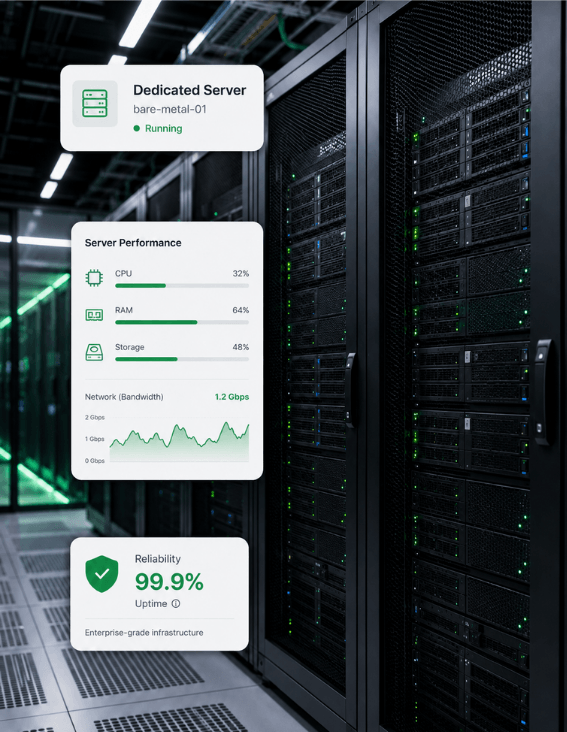
Everything you need to know about self-hosting MongoDB on GreenGeeks VPS.
MongoDB is a document database used to store application data as flexible JSON-like records called BSON documents. Typical workloads include web and mobile application back ends, content management systems, product catalogs, real-time analytics dashboards, IoT and event streams, gaming leaderboards, and any case where the schema changes often. Large news publishers, online retailers, banks, and gaming companies run it in production. The same engine handles a single small app on one VPS and a sharded cluster spread across many machines for high-volume workloads.
MongoDB calls Community Server source-available under the Server Side Public License. The Open Source Initiative does not currently recognize the SSPL as a true open-source license, since its modified Section 13 places copyleft requirements on parties offering MongoDB itself as a service. The source code remains public, free to read, modify, and redistribute for internal use, and most application teams self-hosting it on their own servers operate fully inside the terms.
MongoDB recommends allocating 50 to 60 percent of system RAM to the database and aiming to keep the entire working set — meaning your active data plus its indexes — in memory at all times. A practical sizing rule is two to three times the working-set size in RAM. The WiredTiger storage engine defaults its cache to half of system RAM minus one gigabyte. If the working set spills outside memory, the OS starts paging from disk and query latency degrades sharply.
The fastest path is to pull the official image and run it on the default port 27017. The single command docker run -d -p 27017:27017 -v mongo-data:/data/db mongodb/mongodb-community-server starts a working server with a persistent volume on the host. Docker Compose is the recommended deployment method for production-style setups that include authentication, a custom configuration file, and a healthcheck. The official image is maintained by MongoDB Inc. and tracks each major version with clean tagged releases.
Sharding distributes a collection across multiple servers using a chosen shard key, so the dataset can grow beyond what one machine can hold or serve. A production sharded cluster runs each shard as its own replica set for safety, plus dedicated config servers that hold cluster metadata and mongos query routers that direct application traffic. MongoDB 8.0 distributes data across new shards up to 50 times faster than 7.0, which makes it easier to grow capacity by adding hardware.
MongoDB Community Server is free to download and run on your own hardware under the Server Side Public License. There is no per-server, per-core, or per-user fee, and there is no time limit on free use. MongoDB Atlas, the managed cloud version, has a free shared tier and paid plans starting around 25 dollars per month for smaller shared clusters. Self-hosting Community Server on a VPS keeps your data on infrastructure you control, with no per-cluster license cost.
Community is the self-installed database engine that you run on your own server, with full root access and no per-instance license fee. Atlas is MongoDB Inc.'s managed cloud service, which handles provisioning, patching, backups, monitoring, and automatic failover, on dedicated tiers starting around 58 dollars per month. Atlas also adds features that Community does not include, such as Atlas Search and Atlas Vector Search, while Community covers the core database, replication, sharding, and transactions feature set.
Yes, MongoDB Community Server runs cleanly on a Linux VPS with root access. You install it from the official apt or yum repository, from the official Docker image, or by compiling from source, then optionally configure a three-node replica set if you need automatic failover. The standard production guidance includes SSD storage for low latency, enough RAM to hold the working set, multiple CPU cores for concurrent operations, and a few Linux tuning steps such as disabling Transparent Huge Pages on the host.
A replica set is a group of mongod processes that maintain the same data set across multiple servers. One node is elected as the primary and handles all writes, while the other nodes serve as secondaries that copy the data and stand ready to take over. If the primary fails, the surviving nodes hold an automatic election and promote a new primary. Three nodes is the standard production minimum, since multi-document ACID transactions and several other features require a replica set rather than a standalone install.
Yes, multi-document ACID transactions arrived in MongoDB 4.0 in 2018 for replica sets and were extended to sharded clusters in version 4.2. Transactions require a replica set even on a single host, since standalone deployments cannot run them at all. The transactional API matches the patterns developers know from relational databases, with begin, commit, and abort calls available through every official driver. Most application back ends do not need transactions for routine reads and writes, but the option exists for genuinely cross-document workflows.
Run free MongoDB Community Server on GreenGeeks VPS hosting — RAM headroom for the WiredTiger working set, dedicated CPU for aggregation pipelines, fast SSD for collection files, and nightly backups, all on 300% renewable-powered servers.
Generous RAM keeps the WiredTiger cache holding the working set.
Dedicated CPU keeps aggregation pipelines responsive under concurrent load.
Fast SSD cuts I/O lag on collection files and the WiredTiger journal.
300% renewable energy match on every VPS.