
“Powered by renewable energy” can refer to an annual certificate purchase that supports market-based accounting. A project contract can create a closer connection by naming the generating project and transferring the related RECs to the buyer, while direct facility supply may document electricity delivered to a named site. The label becomes useful when the provider's evidence supports its exact public statement. Procurement records document purchased electricity attributes under market-based accounting; facility location shows the physical grid serving the workload, and efficiency reports add an operating measurement by showing how much facility energy supports computing equipment.
What a Green Hosting Label Means
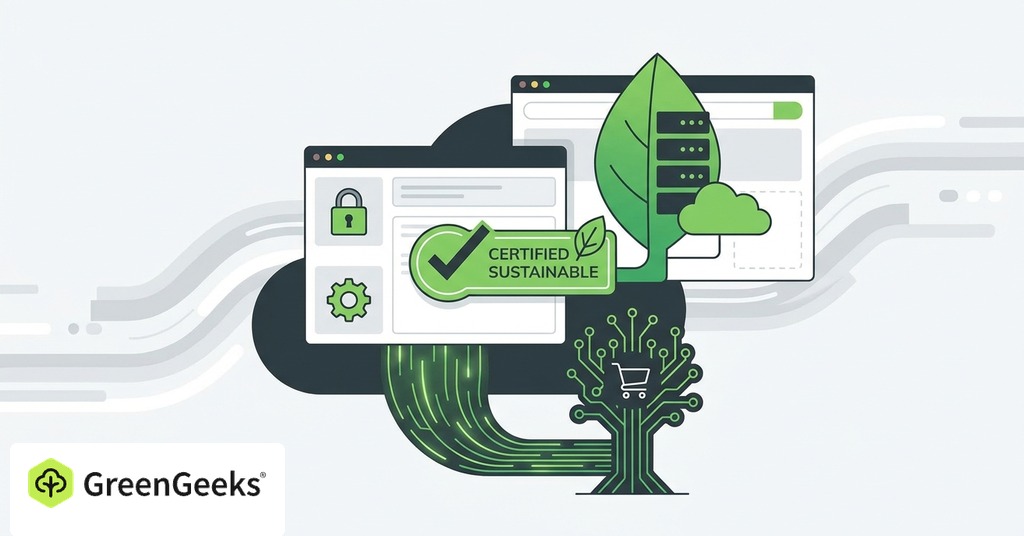
Green hosting is a marketing and procurement category with no universal technical specification, so providers support the label with different forms of evidence. REC purchases support renewable electricity accounting, while a project contract can create a longer financial connection to generation and offset finance addresses an emissions claim. Efficient data-center design supplies operating evidence.
An annual REC match can be compared with another annual REC claim that uses the same boundary and reporting year, whereas hourly supply needs a time-matched comparison and offset-backed emissions require a project-quality review.

A hosting plan still has to satisfy the site's reliability and security requirements, including a recovery process fitted to the workload and support that covers the owner's likely failure cases. Environmental evidence becomes a purchasing factor among the plans that meet those operating needs.
Electricity Claims and Physical Power
Shared Grid Electricity
Regional grid electricity is mixed.
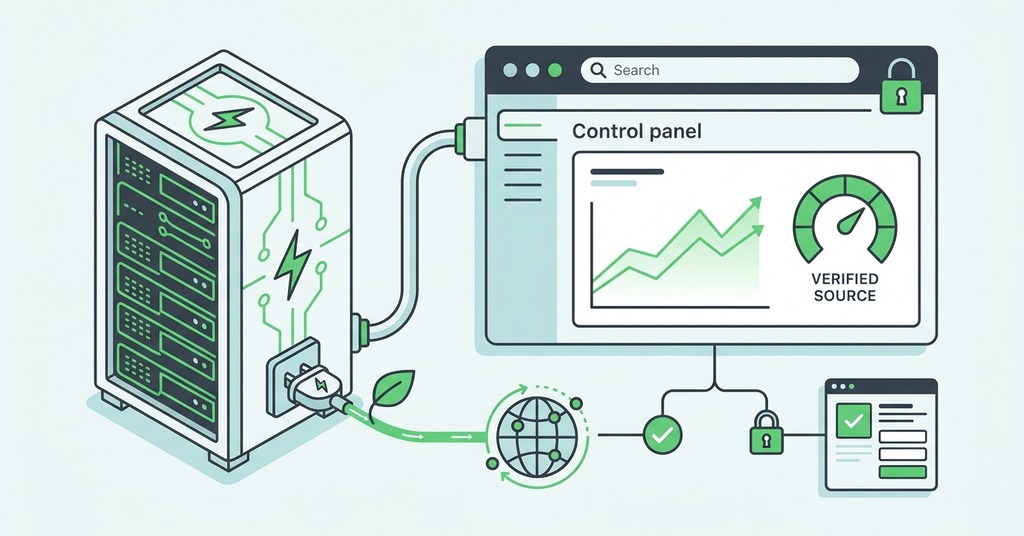
A data center draws from that grid at the time its equipment operates, even when the operator buys renewable attributes equal to its annual use. The electrons from a named wind project are not routed to one customer's server.
A dedicated supply contract can create a closer physical relationship depending on its delivery arrangement, with regional sourcing and time matching providing more information about the electricity available when demand occurs.
Ask the provider to identify the data-center locations serving the plan. A claim with no facility or market boundary cannot show which grid conditions apply to the service.
Renewable Energy Certificates
A renewable energy certificate represents the renewable attributes of 1 megawatt-hour of eligible generation. The generator produces electricity for the grid and can transfer the attribute through the certificate to a buyer that owns and retires the REC for a market-based renewable electricity claim. Retirement prevents the certificate from supporting another buyer's claim, while geographic market rules and resource eligibility also affect validity. Independent certification can document chain of custody while controlling duplicate claims. Carbon offsets use a different instrument and address a different accounting purpose. A REC leaves physical electricity on the shared grid and supplies no proof that a new wind or solar project was built because of the purchase.
REC ownership assigns the renewable attribute to one buyer and supports demand for qualified generation, with the public statement remaining within the accounting boundary covered by the instrument.
Low-priced certificates supply little project revenue and provide weak evidence that the purchase caused new generation. Additionality requires a connection between the procurement and a project that needed that commitment.
Power Purchase Agreements
A power purchase agreement is a contract for electricity or its associated attributes from a project, and a long commitment can give a developer predictable revenue that helps finance construction. A short agreement for output from an operating project usually provides less evidence that the buyer enabled new generation. REC ownership gives the renewable reporting right to the party named in the contract, while project location identifies the grid market receiving the generation. Delivery records show if the agreement supports annual accounting or time-matched claims.
Carbon Offsets
Carbon offsets represent verified reductions or removals outside the buyer's direct or indirect emissions boundary, answering a different accounting question from renewable electricity procurement. A hosting page that swaps the terms prevents a buyer from identifying what was purchased.
An offset method sets the baseline used to calculate reductions. If that baseline assumes emissions that were unlikely to occur, the issued credits can overstate the avoided amount. For removals, the claimed benefit lasts only while the stored carbon remains out of the atmosphere. Independent verification checks the project against its selected method, so a buyer still needs to judge if that method fits the public claim.
Scope 2 and Matching Periods
Location-Based and Market-Based Results
In greenhouse gas accounting, Scope 2 covers indirect emissions associated with purchased electricity. A location-based calculation applies average grid emissions to consumption at the facility, describing the regional system that physically serves it. A market-based calculation applies qualifying contractual instruments to consumption during the reporting period. Presenting both results shows the difference between regional grid conditions and the effect of the provider's electricity procurement.
A claim may cover only office electricity, with cooling and power distribution at a third-party data center falling into another boundary. State that boundary in ordinary language.
Annual and Hourly Matching
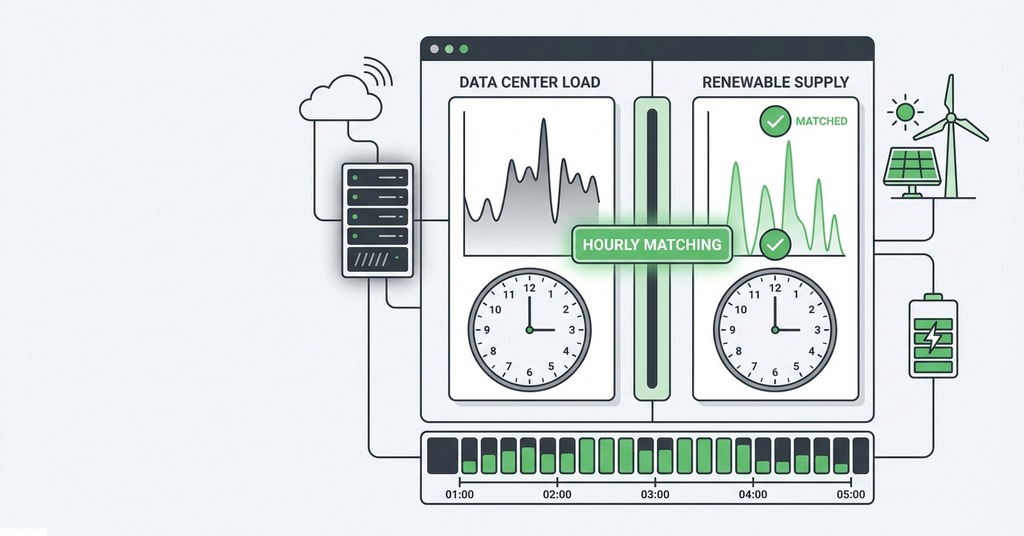
Annual matching compares total qualifying renewable attributes bought during a year with electricity consumption over that year, even though demand at a particular facility can occur during hours when the local grid depends more heavily on fossil generation.
Hourly carbon-free energy programs compare consumption with carbon-free supply in the relevant region for each hour, using facility-level consumption records matched to regional generation data with the same interval and time zone.
Annual matching is a valid market-based claim when its instruments are eligible and retired. Any public wording should preserve that annual matching scope.
Verification and Additionality
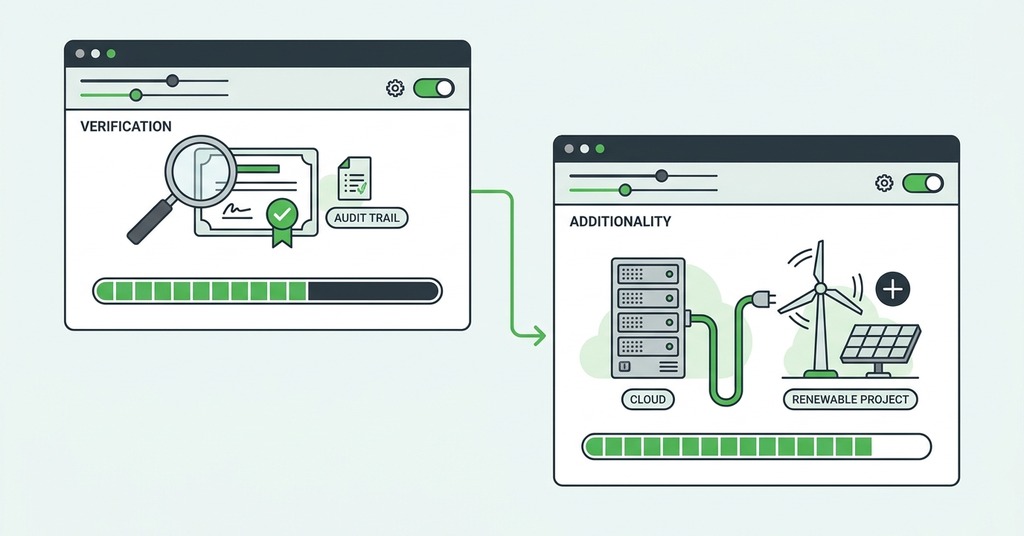
Verification should test the percentage calculation as well as the instrument purchase because the electricity total and renewable-attribute quantity must cover the same reporting period and organizational boundary before a matching percentage is valid.
Regulatory mandates matter because an attribute already used to satisfy a required renewable target may not remain available for a voluntary claim. A registry record lets the buyer check the retirement date and named claimant.
Physical-delivery claims need metered facility supply. A certificate verification badge by itself cannot establish that physical delivery.
Additionality asks if the buyer's commitment changed the project's ability to proceed. A long-term agreement executed before construction may help answer that question through financing records. Certificate eligibility alone supplies no evidence of project causation.
Data Center and Website Efficiency

Renewable procurement does not remove the value of using less electricity. Facility disclosures can include power usage effectiveness with a reporting period and defined boundary. Server utilization and cooling design add operating context, with water use also material in some locations.
One unexplained efficiency number is weak evidence because an annual average can hide seasonal demand, and a portfolio average can hide differences among facilities. Ask which data center serves the hosting plan and which period the measurement covers.
Website design changes the infrastructure workload. Smaller images reduce transfer. Caching can reduce repeated application work, while static delivery may avoid database processing for suitable pages.
Third-party scripts and autoplay video add requests or computation. Removing unused code can reduce page weight and improve visitor performance at the same time. Site efficiency and host procurement address different parts of the footprint, so both can contribute.
The GreenGeeks Claim, Annotated
Evidence in the Current Record
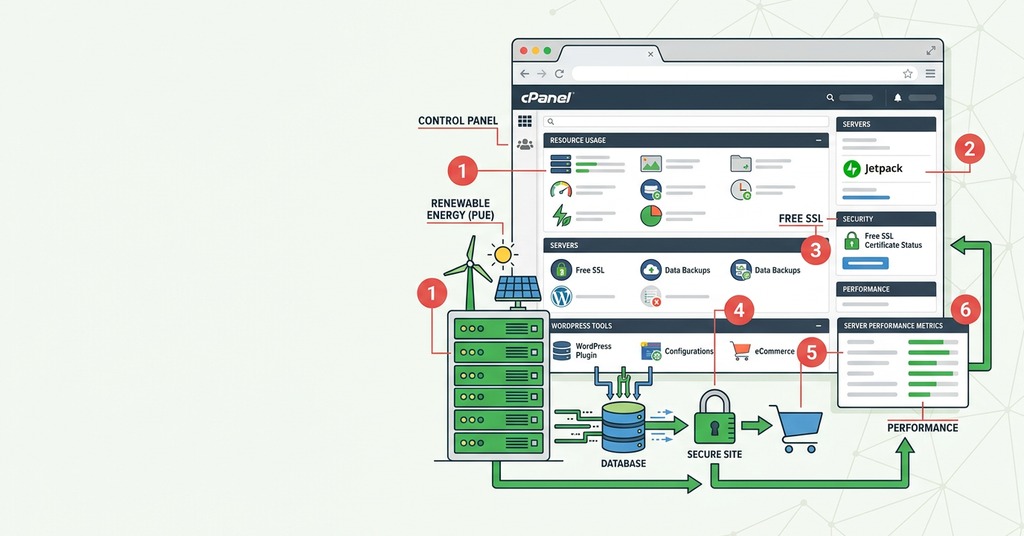
GreenGeeks makes a traceable annual procurement claim through purchased renewable attributes. EPA's partner record for GreenGeeks lists 3,768,000 kWh of annual green power use, with wind identified as the resource. It names Bonneville Environmental Foundation as the supplier for the renewable energy certificate program. GreenGeeks' 300% figure means it buys qualifying annual attributes equal to three times the electricity consumption within the stated boundary.
Boundaries of the 300% Match
The partner description scopes the match to “web hosting servers energy consumption.” Cooling and power distribution belong to a different facility boundary unless reporting explicitly includes them.
The record reports 0 kWh of on-site generation, so the evidence describes purchased annual attributes. Fossil-free operation by facility and hour would require regional generation matched to timestamped consumption. Evidence of additional generation would require a documented project-finance connection.
GreenGeeks describes tree planting as an additional project for new accounts. Treat that as an independent project whose evidence cannot substantiate the renewable electricity match. A carbon-neutral statement about that work would require quantified project data.
A Buyer Test for Green Hosting
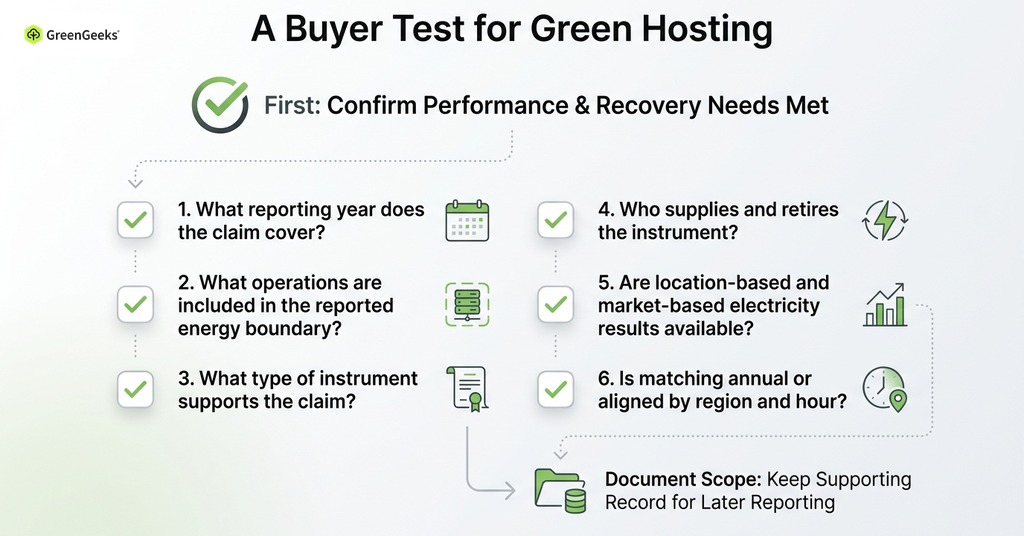
First confirm that the host meets the site's performance and recovery needs. Once those needs are met, use these questions to examine the environmental claim.
- What reporting year does the claim cover?
- What operations are included in the reported energy boundary?
- What type of instrument supports the claim?
- Who supplies and retires the instrument?
- Are location-based and market-based electricity results available?
- Is matching annual or aligned by region and hour?
- Which efficiency metrics have a facility and reporting period?
- What evidence supports any claim of new generation?
- Which material electricity use or emissions are excluded?
Keep the supporting record with the hosting evaluation so later reporting uses its documented scope. For GreenGeeks, the checked evidence supports a 300% annual wind REC match for the stated server-energy boundary. Facility-wide or hourly claims would require more detailed operating records.