
Entry plans in shared hosting renew at two to six times what they advertise, with SiteGround’s StartUp going from $2.99 to $17.99 and Namecheap’s Stellar from $2.28 to $4.66.
A few dollars a month still buys a working product, though the low tier buys it alongside a published set of ceilings on files, CPU seconds, backup frequency and support, all of them readable before purchase. Both numbers, the one on the ad and the one on the renewal notice, appear on a host’s own pages.
| Topic | Key Point |
| Renewal pricing | The advertised number is what the first invoice costs |
| What gets cut | Four published ceilings, all readable before purchase |
| Three-year math | The ranking changes depending on the year measured |
| GreenGeeks | Top pick, LiteSpeed on NVMe with daily backups included |
| Hostinger | Lowest four-year cost on a 48-month prepay |
| InterServer | One plan at $7, locked for the life of the account |
| DreamHost | Monthly billing on every plan, renewal printed on the card |
| ChemiCloud | Publishes cores, RAM and inodes on the pricing table |
| InMotion Hosting | 100 GB at the entry tier, backups sold separately |
| SiteGround | Support-led pick with the steepest renewal step here |
| Krystal | UK and EU, publishes processes and cores openly |
| Bluehost and HostGator | Biggest brands, hardest ownership questions |
| Community picks | The curated lists disagree with the affiliate lists |
| The verdict | Which of the two numbers the buyer pays |
The Gap Between Intro Price and Renewal Price
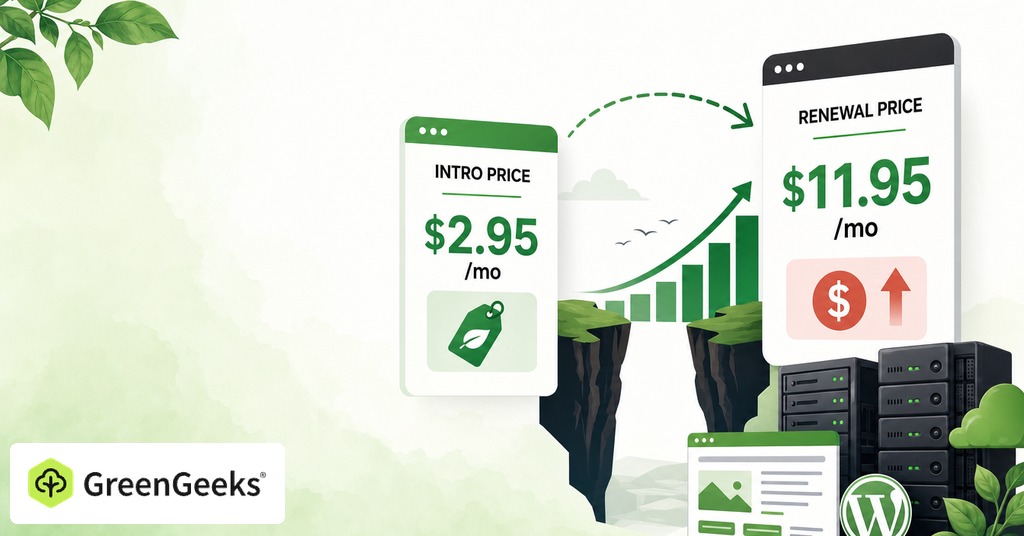
Almost every mainstream budget host discounts the first term by between 60% and 83%. The advertised price is customer acquisition cost, and the regular price is what the product costs to run. That discount applies to the first invoice and to nothing after it.

The Intro-to-Renewal Spread in 2026
| Host | Entry plan | Intro | Renewal | Multiple |
| SiteGround | StartUp | $2.99 | $17.99 | 6.0x |
| ChemiCloud | Starter | $2.49 | $11.95 | 4.8x |
| GreenGeeks | Lite | $2.95 | $13.95 | 4.7x |
| ScalaHosting | Mini | $2.95 | $11.95 | 4.0x |
| InMotion | Core (1yr) | $2.99 | $11.99 | 4.0x |
| DreamHost | Launch | $2.89 | $10.99 | 3.8x |
| Hostinger | Premium (48mo) | $2.99 | $10.99 | 3.7x |
| HostGator | Hatchling | ~$3.75 | $10.99 | ~2.9x |
| InterServer | Standard | $2.50 (1 month) | $7.00 | flat after month one |
| Bluehost | Starter (36mo) | $3.99 | $9.99 | 2.5x |
| Namecheap | Stellar | $2.28 | $4.66 | 2.1x |
| IONOS | Essential | $4.00 | $8.00 | 2.0x |
The multiples are the least useful column in that table, because the headline almost always requires the longest term paid upfront in full, so Hostinger’s $2.99 is a 48-month commitment billed at $143.52 on the day of signup, and HostGator bills the whole three-year Hatchling term at signup, a total of $395.61 once the renewal rate applies.
A low multiple is also not automatically a low price. IONOS’s 2.0x is the result of a smaller discount on a product that was never cheap, while Namecheap’s 2.1x comes with the cheapest renewal in the table at $4.66. Only there does a small multiple mean what a buyer hopes it means.
Hostwinds is outside the table for a different reason. Its $4.54 intro against a $6.99 renewal is the smallest step anyone here offers, a genuine point in its favor.
InterServer is the one row where the multiple column stops meaning anything. Its $7 rate comes with no term discount to chase.
What Is Pushing Regular Hosting Prices Up
The supply side explains more of this than greed does. cPanel raised every license tier again on January 1, 2026:
Solo from $16 to $18
Admin from $19.75 to $21
Pro from $27.25 to $32
Premier from $47 to $49.50
That is the seventh consecutive annual increase since cPanel moved to per-account pricing in 2019, and combined cost is up more than 55% across most tiers, so a provider running 20 servers on the Pro tier now pays over $640 a month in control-panel licensing before a single customer exists. Plesk announced an average 26% increase for the same January.
Hostinger’s hPanel, ScalaHosting’s SPanel, InterServer’s DirectAdmin and DreamHost’s custom panel each remove a per-account license fee from the cost floor. Hosts that do not run cPanel price flatter for it, and their renewal numbers are lower.
What Gets Cut on a $3 Hosting Plan
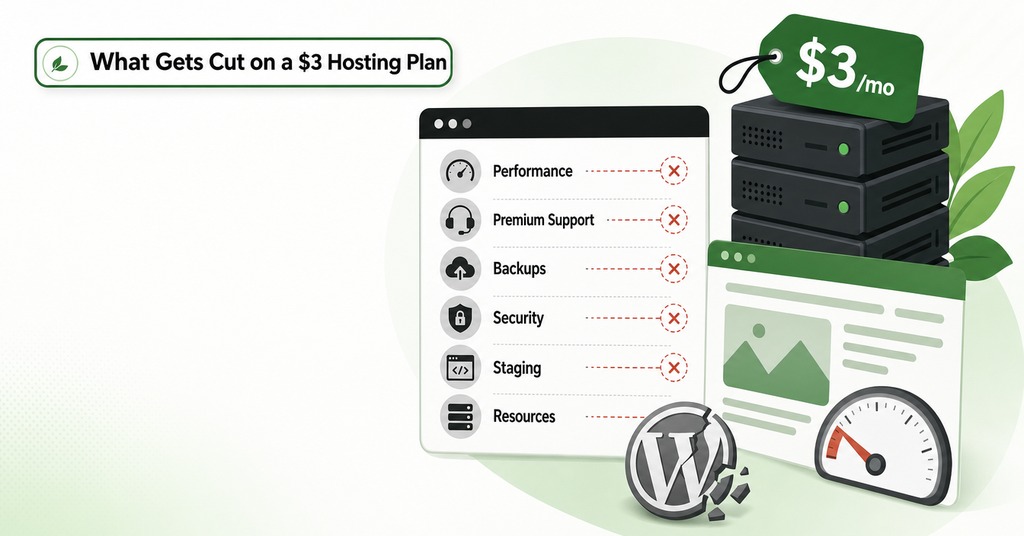
The four ceilings below are where the $2.95 comes from. Three of them have a published number the buyer can look up before checkout, and the fourth does not.
Inode Limits
An inode is one file. Every folder counts, and so does every separate email message held in a mailbox. A bare WordPress install therefore sits at roughly 20,000 to 25,000 files before a single page is published.
Most published entry-tier numbers are between 200,000 and 300,000, and the interesting cases are the two hosts whose published number is not the one they enforce. HostGator sets a 100,000 soft limit above which the account silently drops out of weekly backups, applies a 20 GB size threshold that does the same thing, and treats 200,000 as a policy violation. Bluehost publishes 50,000 while its own knowledge base says it usually takes no action below 1,000,000.
GreenGeeks enforces an inode quota and surfaces it in cPanel as File Usage, sending a graduated resource alert before acting, though it publishes no per-plan figure. InterServer, ScalaHosting, Hostwinds and InMotion publish no inode number either, which leaves the ceiling in place and out of view.
CPU, RAM and Entry Processes
A cheap plan that passes this second ceiling slows down, and outright failure is the rarer outcome, though each host measures the allowance in its own units, so the comparison is difficult before any number is read. The two ends of the practice:
SiteGround meters CPU seconds rather than percentages, at 1,000 an hour and 300,000 a month on its entry plan.
HostGator caps a percentage instead, at 25% CPU with 25 simultaneous processes and 25 concurrent MySQL connections.
No two hosts here measure the same thing. Comparing CPU allowances across a shortlist produces nothing usable. ScalaHosting publishes a per-account ceiling of 3% on Mini in its terms of service, while Bluehost, InMotion, InterServer and Hostwinds publish nothing here at all.
An account at its process limit returns HTTP 508, and an account past the plan’s wider limits returns 503, neither of which tells the visitor what happened.
Backup Frequency and Retention
The roster splits close to evenly between hosts that include a daily copy at the entry tier and hosts that do not.
Daily at the entry tier: GreenGeeks, ChemiCloud, DreamHost, IONOS, Krystal and SiteGround.
Weekly at the entry tier: InterServer, Hostinger’s Premium tier, Bluehost and HostGator.
Neither, without paying: InMotion sells backups as an add-on, and Namecheap Stellar states only that internal backups are ideally performed twice a week though not guaranteed.
HostGator’s weekly rotation is conditional in the way described above. Hostwinds, separately, advertises nightly backups on its marketing page while its terms of service state it takes no backups of any kind.
Support
Support is the one ceiling with no published number, so a buyer cannot verify it before purchase the way an inode cap or a backup schedule can be verified. It costs labor above all, so it tiers with price, and offshoring is the standard way of reducing it.
That unverifiable quality is also why some buyers accept the highest renewal price here and treat the renewal step as what the support desk costs.
Cheapest Headline or Cheapest Three Years?

The three-year arithmetic changes the ranking. GreenGeeks Lite over three years is $35.40 for year one plus $334.80 for years two and three, so $370.20. SiteGround StartUp on the same structure is $35.88 plus $431.76, so $467.64. InterServer is $2.50 plus 35 months at $7, so $247.50. Bluehost Starter on a 36-month prepay is $143.64 for the whole three years before the renewal rate begins.
Only two of those four totals came from the two cheapest headline prices, so the year being optimized for decides the winner before any feature comparison starts.
GreenGeeks, Best Cheap Web Hosting Overall

GreenGeeks is the top pick because of the stack underneath its entry tier. Lite, the entry tier of its shared hosting plans, runs LiteSpeed Enterprise with LSCache on NVMe SSD in RAID-10, with PHP 8.4, HTTP/3 over QUIC and a free Cloudflare CDN. It is $2.95 a month prepaid for 12 months and renews at $13.95, a 4.7x step that sits mid-table.
Server-level caching is the difference between a traffic burst reaching PHP and being answered before it gets there, and it shows up in testing. An April 2026 load test at 50,000 visitors recorded a 26 ms response time at 100 concurrent users with zero errors, alongside a 418 ms TTFB in the same run. Any single TTFB number deserves caution, because 2026 testing moves the same host by an order of magnitude depending on test location, concurrency and the state of the CDN. Independent monitoring across 2024 and 2025 logged 99.98% uptime against a 99.9% guarantee.
Lite includes 25 GB of storage, unmetered traffic, daily backups, free website transfer handled by the support team, free SSL, 24/7 support and a 30-day money-back window. Two of those, daily backups and hands-on migration, are paid add-ons or DIY plugins at several of the hosts here. Against that, GreenGeeks publishes no per-plan inode figure, and Lite is a single-site plan, so a second site means the Pro tier at $4.95 renewing at $18.95.
Since 2009 GreenGeeks has matched three times its hosting energy use in wind credits through the Bonneville Environmental Foundation, none of which changes what the invoice says.
Hostinger, Lowest Four-Year Cost
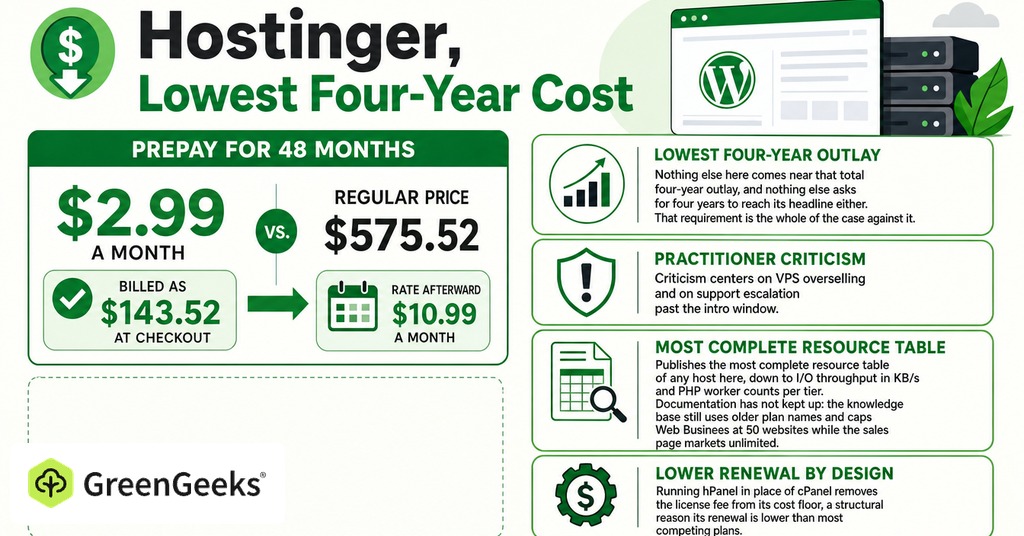
Hostinger Premium is $2.99 a month on a 48-month prepay, billed as $143.52 at checkout against a regular price of $575.52. The rate afterward is $10.99 a month. Nothing else here comes near that total four-year outlay, and nothing else asks for four years to reach its headline either. That requirement is the whole of the case against it. Practitioner criticism centers on VPS overselling and on support escalation past the intro window.
It publishes the most complete resource table of any host here, down to I/O throughput in KB/s and PHP worker counts per tier, though the documentation around it has not kept up, since the knowledge base still uses older plan names and caps Web Business at 50 websites while the sales page markets unlimited. Running hPanel in place of cPanel removes the license fee from its cost floor, a structural reason its renewal is lower than most competing plans.
InterServer, $7 a Month Forever

Storage, transfer, websites and databases are all unlimited under a fair-use policy that says the plan is for websites and email, not file storage or reselling. The stack is LiteSpeed with LSCache on CloudLinux behind DirectAdmin, with no cPanel anywhere in it, and the team does the migration itself, including cleanup of problems found on the way. InterServer publishes no inode, CPU or process figures anywhere and argues openly against fixed limits, which suits a buyer who wants one predictable number and leaves nothing to check for a buyer who needs the ceiling in advance.
The pricing is one plan at $2.50 for the first month and then $7 a month for as long as the account stays open, with no term discount, since 12 months costs exactly 12 times $7. The Price Lock Guarantee holds that $7 rate for the life of the account, and it holds the standard rate only, narrower than the way the guarantee is usually described.
DreamHost, Best for Monthly Billing

DreamHost’s case is a billing policy, and monthly billing is available on every plan without forcing a long term. The exact renewal rate is printed next to the promotional price on every plan card. In a market where the renewal number is the last thing a buyer locates, that lets the second year be priced before checkout.
Web Hosting Launch is $2.89 a month for the first year and renews at $10.99, with 25 GB of NVMe storage, 25 websites, daily automated backups, unmetered bandwidth, a 100% uptime guarantee and its own control panel in place of cPanel. Support is in-house, and it is also the recurring complaint, alongside a $10.99 to $12.99 standing rate above the cheapest options, with some departing customers reporting that shared support failed to resolve persistent problems.
ChemiCloud, the Most Transparent Limits
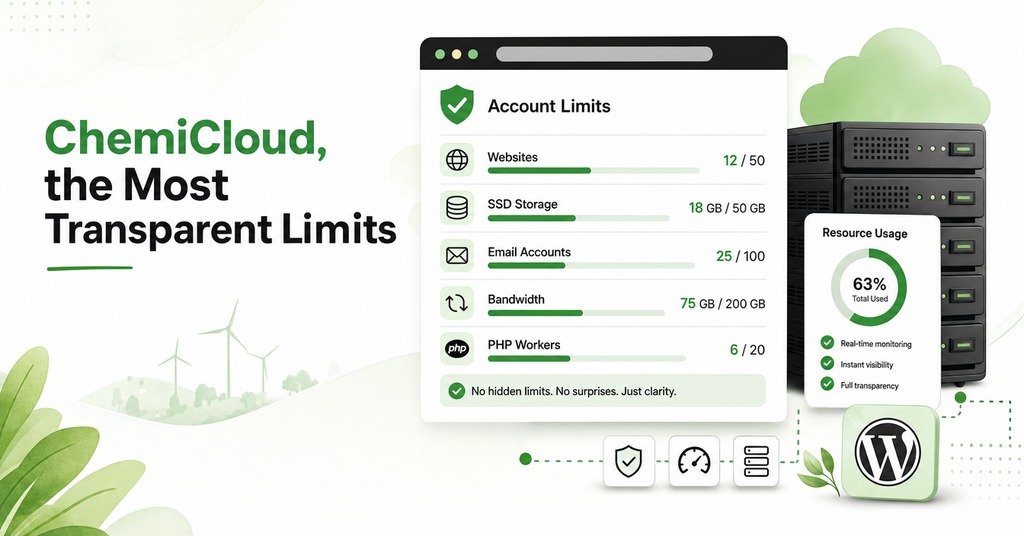
ChemiCloud prints one AMD EPYC core at 3.7 GHz, 2 GB of RAM and 250,000 inodes on the Starter card itself. Almost nobody at this price publishes that much. Starter is $2.49 introductory against an $11.95 regular price on a default 36-month cycle, and it gives 20 GB of NVMe and one website.
Daily offsite backups are included with 10 days of retention on Starter, though one-click restore is listed from the Pro tier up and does not appear on the Starter card at all, which is the line the buyer has to read before committing. Email is free and unlimited with MailChannels delivery, and moving an existing site over costs nothing, email included. The money-back window is 45 days against the 30 days most hosts here offer.
InMotion Hosting Gives 100 GB at the Entry Tier

Core gives 100 GB of storage at the entry tier, four to ten times what most entry plans here provide, though it is plain SSD where the tiers above it are NVMe. The price is $2.99 a month on a one-year term renewing at $11.99, or $3.19 on two and three years renewing at $10.99.
It runs NGINX with its own tuning plus cPanel, and says openly that it chose NGINX over LiteSpeed to avoid license costs. It owns its hardware in Los Angeles, Ashburn and Amsterdam, has been independent for 25 years, and offers the longest refund window here at up to 90 days.
There is no managed daily backup on shared plans, and Backup Manager is an add-on from $2.99 a month, a serious omission on a plan with 100 GB of space to fill. The storage is still the reason to take Core, since a media library that would fill a 10 GB plan in its first year never comes near that ceiling.
SiteGround, Strong Support at the Highest Renewal
SiteGround StartUp is $2.99 for the first invoice and $17.99 afterward, the largest spread in this roster at 6.0x. It buys 10 GB of storage, one website and guidance of around 10,000 monthly visits, on Google Cloud infrastructure with 11 hosting regions and more than 170 CDN edge locations.
SiteGround publishes unusually specific ceilings, at 200,000 inodes as a hard limit, 768 MB of RAM per process and a 30-minute minimum cron interval, on top of the CPU-second metering described earlier. Up to 30 daily backup copies are included on every shared plan with free restores, better than any other entry plan covered here.
Performance testing on SiteGround in 2026 produces inconsistent results, with one test recording a 32 ms TTFB and others putting it between 230 ms and 286 ms, a wider spread than the difference between most hosts here.
The renewal is contested among the people paying it. One customer posted a GoGeek auto-renewal of £604 across 13 low-traffic sites and negotiated it down to £403, and the counter-position from operators managing SiteGround accounts by the hundred is that a $7 to $8 monthly difference is minor against hosting that rarely needs a support ticket at all.
Krystal for UK and EU Hosting

Amethyst is £7 a month monthly, £5.83 on annual and £5.25 on biennial, quoted before VAT, and the pricing page shows no intro-and-renewal split anywhere, unusual enough to be the headline feature. The same page lists 250,000 inodes, 25 processes, one CPU core and 2 GB of RAM. What the page does not do is commit in writing to holding the rate, so the absence of a renewal notice is not the same as a published guarantee of parity.
The stack is LiteSpeed with LSCache on CloudLinux behind a mod_security firewall. Backups are daily snapshots, the uptime guarantee is 99.99%, and the money-back window is 60 days.
Data centers are in East London, Phoenix, Edison and Amsterdam, all ISO 27001 and on renewable power.
Bluehost and HostGator, and Why They Still Rank
Bluehost and HostGator are the two most-searched names in budget hosting and both are Newfold brands. Ownership therefore matters here more than either spec sheet does.
Bluehost is one of only three hosts officially recommended on WordPress.org, and Newfold is migrating it to Oracle Cloud Infrastructure during 2026. Starter is $3.99 on a 36-month prepay and renews at $9.99 on that term, which is mid-table, though backups are weekly unless CodeGuard is bought separately, free mailbox storage on Starter stops at 100 MB, and the free migration is a DIY plugin.
HostGator Hatchling renews at $10.99 on a three-year term, billed as $395.61 upfront, and its published caps are among the most specific of any host here even though its inode policy is among the strictest. During 2026 it began moving customers onto paid cPanel Email tiers priced by active mailbox count, with accounts holding 7 mailboxes and under 50 MB of mail in total moved to a $35.88 annual tier.
The ownership question matters most on a three-year prepay. Moody’s downgraded Newfold to Caa1 in February 2025 and Caa3 in September 2025, and the company closed $100 million of new financing in December 2025 and sold MarkMonitor for around $450 million at the end of that year. None of that means the hosting stops working, though it does mean the balance sheet is a live consideration on a long prepay. Ownership changed elsewhere in budget hosting too. HostPapa completed its acquisition of Hostwinds in April 2026, while IONOS answers the staying-power question differently again as a publicly listed operator running US hosting from its own Kansas facility.
What the Hosting Community Recommends

The curated community lists and the affiliate lists do not agree, and the distance between them is wide enough to matter before either one is trusted.
The r/webhosting moderators publish a recommendation thread built from hosts the mod team has personally used, last updated in July 2026. Its US picks are NixiHost, KnownHost and InMotion Hosting, with Zume and Krystal for the UK and EU, on stated criteria of no hidden fees, published renewal rates, in-house support and financial staying power. That thread recommends against relying on mega-brands with very low intro pricing, and names HostGator, SiteGround and Bluehost specifically, while GreenGeeks does not appear on the list at all.
Elsewhere in the same forum GreenGeeks comes up in a narrower role, named in a 2026 thread on HostGator’s email repricing as a cPanel-based alternative with free migration and with the first-year discount flagged as a caveat, and named again on a thread about SiteGround alternatives alongside NameHero. That is a narrower endorsement than a list placement, and it arrives with the renewal caveat attached.
The other consistent community position is structural, built on keeping off-provider backups, prepaying no more than the buyer can afford to lose, and expecting prices to rise at any host. Knowing how to move a WordPress site without help is what makes that advice usable.
Is a Few Dollars a Month Too Good to Be True?

No, provided the buyer prices the second number. Four figures settle it before a card is entered, and only one of them is the advertised rate. The renewal figure multiplied by 24 gives the cost of years two and three, and the inode ceiling alongside the backup frequency covers the two limits a small site meets first. The fourth is the refund window, which runs from 72 hours at Hostwinds to 90 days at InMotion.
By that test ChemiCloud and Krystal are the most forthcoming hosts here, with GreenGeeks covering three of the four and pointing to File Usage in cPanel for the fourth. Where none of the four appear on a host’s own pages, the buyer finds out what the plan allows only after the account is running and the second invoice has arrived.
Frequently Asked Questions

How much should web hosting cost per month?
Entry shared plans advertise between $2.28 and $4.00 a month in 2026 and renew between $4.66 and $17.99. Budget for the renewal figure, since it is what you pay every year after the first.
Why does web hosting cost more when it renews?
The advertised price is a first-invoice discount of roughly 60% to 83% used to acquire the customer, and the regular price is what the product costs. Supplier costs are also rising, with cPanel raising license tiers for the seventh consecutive year in January 2026.
What is an inode limit in web hosting?
An inode is a single file, folder or email message, and hosts cap how many of them an account may hold. A WordPress install uses roughly 20,000 to 25,000 before you add any content.
What does “unlimited” web hosting really cover?
Unmetered under a fair-use policy. InterServer states plainly that its unlimited plan is for websites and email rather than backup storage or reselling, and Namecheap’s unmetered disk is bound by its acceptable use policy.
Do I have to pay for a whole year of hosting upfront?
For the advertised price, usually yes, and often longer than a year. Hostinger’s $2.99 rate requires a 48-month prepay of $143.52 and HostGator bills the full term at signup. DreamHost is the notable exception, with monthly billing on every plan.
Are backups included with cheap web hosting?
It varies more than any other feature. Daily backups are included at the entry tier on GreenGeeks, ChemiCloud, DreamHost, IONOS and Krystal. Bluehost, HostGator, InterServer and Hostinger Premium are weekly, and InMotion sells backups as a $2.99 add-on.
Is free website migration really free?
At most hosts here it is free and done by their own team, GreenGeeks, InterServer, InMotion and HostGator among them. Bluehost’s free migration is a DIY WordPress plugin, and IONOS sells migration as a paid service.
What happened to A2 Hosting?
The brand no longer exists. World Host Group acquired A2 Hosting in January 2025 and rebranded it to Hosting.com in April 2025, and a2hosting.com now redirects there.
Who owns Bluehost and HostGator?
Both are Newfold brands, owned by Clearlake Capital and Siris Capital. Moody’s downgraded Newfold to Caa1 in February 2025 and Caa3 in September 2025.
Can I avoid the renewal price by opening a new hosting account?
It breaches most hosts’ terms. ScalaHosting goes further and reserves the right to refuse a new package for the same domain for 12 months if a customer declines to renew at the standard price.
Is the free domain with a hosting plan really free?
For the first year only, and hosts deduct its regular cost from any refund. HostGator deducts $15.00 to $17.99 and Bluehost deducts $15.99, and ChemiCloud only includes a free domain on 36-month plans.
Should I choose the cheapest hosting or the cheapest three-year cost?
Decide which one you are optimizing for first, because they are different hosts. Over 36 months InterServer costs about $247.50, while a $2.99 headline on a 6.0x renewal reaches roughly $467.64.