
The GDPR covers any site that offers goods or services to people in the EU or monitors their behavior, wherever its servers run. Article 3 sets that test. Such a site owes its EU visitors a privacy policy, a signed agreement with every processor and a one-month deadline on deletion requests. Server location settles the narrower question of how much transfer paperwork the site keeps on file.
Three months went into one Frankfurt-only cloud deployment built on the belief that the law required EU storage, and a contract review would have done the same job in two weeks.
Does Server Location Decide Which Privacy Rules Apply?
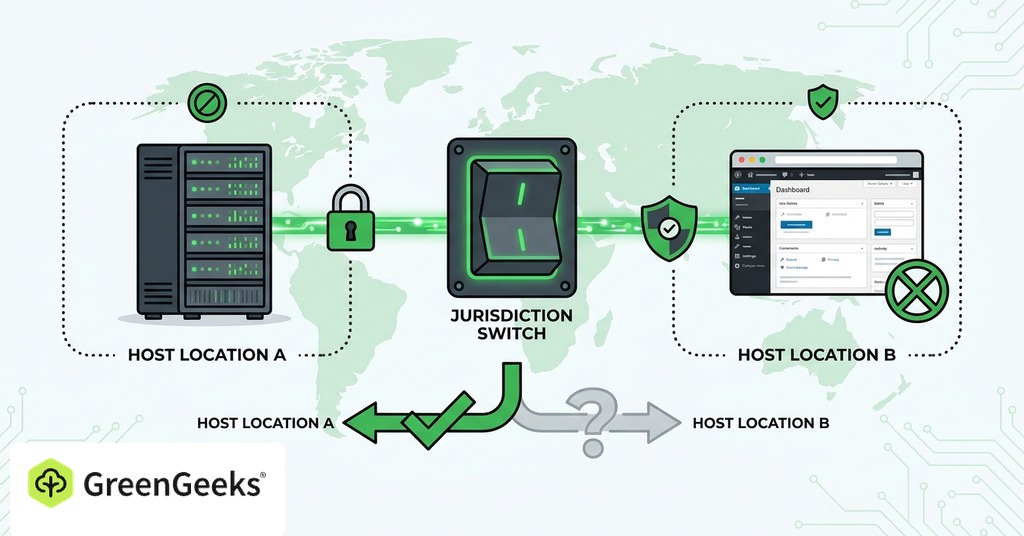
No. Article 3 sets the test on what a site does and who it reaches, covering any organization that offers goods or services to people in the EU or monitors their behavior. A free newsletter with analytics tracking meets that test, and so does a US online store with euro pricing or ads aimed at EU countries.

Protection attaches to a person’s location at the moment of processing, whatever passport they hold. A US tourist checking out from a hotel in Paris is covered. An EU citizen browsing from New York is not, for the processing that happens while he is there. The question is where the person stands when the offer is made or the behavior is watched.
A site merely reachable from the EU, with no EU language options or euro pricing and no marketing aimed at the EU, is arguably out of scope. Accessibility on its own is not a targeting indicator, while euro pricing and EU-directed advertising both are.
The GDPR has no general small-business exemption. Its only carve-out relieves organizations under 250 employees of some record-keeping duties. A site in scope with no EU establishment also has to appoint an EU representative as a contact point for regulators and visitors.
Does GDPR Require Data to Be Stored in the EU?
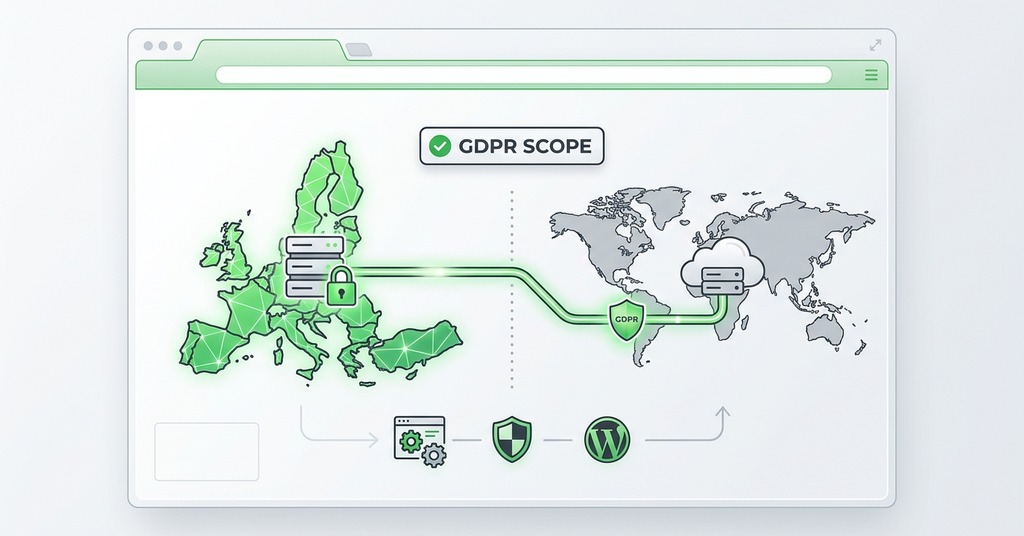
No. The GDPR regulates transfers of personal data out of the EU and EEA under Chapter V, and it sets no requirement about where data is stored. Every transfer needs one of three legal mechanisms. An adequacy decision covers the destination country, Standard Contractual Clauses bind the importer, or a narrow derogation applies. Storing data inside the EU removes the question altogether, which is why hosts sell EU regions as a compliance shortcut.
The Frankfurt deployment shows the pattern in full. The build took a quarter to complete, a locked-down, single-region architecture with regional failovers, put together on the conviction that the regulation demanded it. The working fix was Standard Contractual Clauses plus a Data Processing Agreement review, a two-week job. The mistake was confusing data residency, a choice about where data is physically stored, with data sovereignty, the question of whose law governs it.
European courts invalidated the EU-US Safe Harbor deal in 2015. Its replacement, Privacy Shield, fell to the Schrems II ruling in July 2020. The current EU-US Data Privacy Framework dates to July 2023 and covers 2,700 self-certified US organizations as of mid-2026. It survived its first court challenge in September 2025 with further challenges still working through the courts. Because two of these frameworks have already fallen, executed Standard Contractual Clauses stay on file as a fallback.
Because jurisdiction follows incorporation as well as geography, a provider’s region list reads differently than it first appears. The US CLOUD Act of 2018 lets US authorities compel US-incorporated companies to produce data they control, wherever it is stored. A US provider’s Amsterdam region gives EU residency, while full insulation from US legal reach requires an EU-incorporated provider. For most small sites the distinction is academic.
If Location Is Not Required, Why Host in the EU at All?

Hosting EU-visitor data inside the EEA removes the transfer question entirely. The adequacy analysis drops off the list along with the contract clauses, as does the standing job of watching the courts for the next invalidation. It is the simplest path available, and even the firms that sell transfer paperwork describe it that way.
The region picker only sets where the primary database lives. Teams choose Frankfurt for that database and stop there, while nightly backups replicate to a bucket in Virginia and CDN edge nodes cache responses and write request logs on other continents. A support engineer opening a session from a third country counts too. Every one of those is a transfer under Chapter V, including the remote access, even though no data visibly moved. The work is tracing where the data goes after it leaves the primary server, into backups, logs, analytics, the email provider and every support session. The inventory starts with the primary server and does not end there.
What Changes If the Server Is in Canada or the US?

The EU maintains an adequacy decision for Canadian commercial organizations covered by PIPEDA, so personal data flows from the EU to a Canadian host without contract clauses. Inside Canada, PIPEDA does not require data to stay in the country. It instead keeps the collecting organization accountable for what a foreign processor does with the data, which comes down to contracts and privacy-policy transparency, plus a breach-reporting duty that holds even when the breach happens at a US vendor.
Quebec has the strictest privacy statute in North America. Law 25, fully in force since September 2024, applies to any organization worldwide that handles even one Quebec resident’s data. It requires a publicly named privacy officer, a privacy impact assessment before data leaves the province, and tracking technologies off by default until the visitor opts in. Penalties reach CAD 25 million or 4% of worldwide turnover. Complying with Law 25 satisfies PIPEDA.
A US-located server is workable for EU-visitor data once the transfer mechanism is documented, and a host certified under the Data Privacy Framework already supplies that mechanism. Without certification, the site needs Standard Contractual Clauses and a Transfer Impact Assessment, neither of which takes long for a small site. Each is a one-time document per vendor, filed once and revisited only when the vendor or the law changes.
What a Small Site Owner Has to Do
The Paperwork Baseline
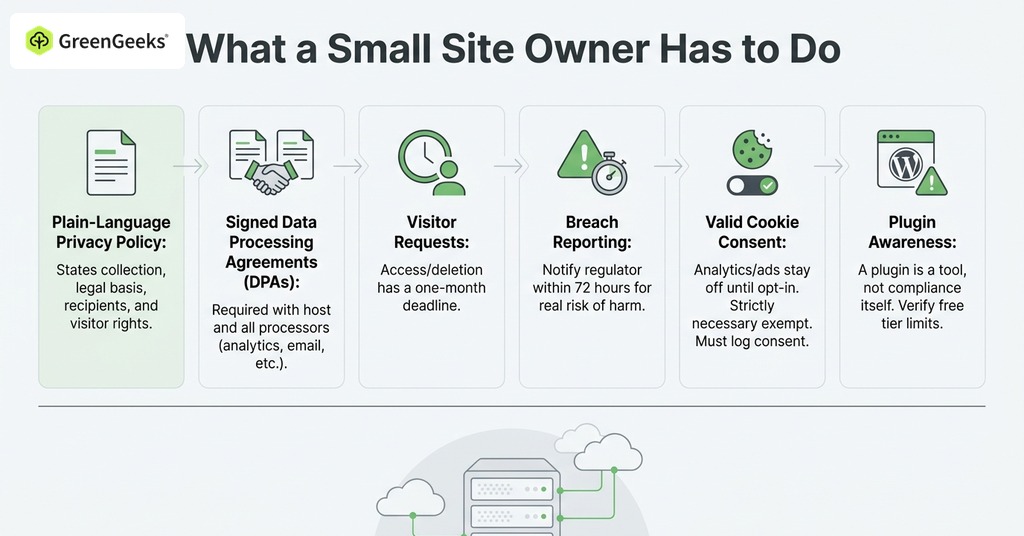
No matter the server location, a site in scope of the GDPR owes the same core duties. You need a plain-language privacy policy that states what you collect and why. It also sets out the legal basis for each use and the recipients of the data, then tells visitors what rights they can exercise. A signed Data Processing Agreement is required with the host and every other processor that touches personal data, from the analytics tool to the email service. Visitor requests for access or deletion have a one-month deadline. A breach with real risk of harm goes to the regulator within 72 hours.
The DPA is routine paperwork. The host publishes a pre-signed PDF. You fill in the exporter fields and the signature boxes, then email it to a privacy inbox and wait for the countersigned copy. That copy goes into the same folder as the privacy policy and the consent logs, which is what compliance at this scale amounts to.
The Cookie Banner Question
The rules behind the banner come from separate laws that are routinely collapsed into one. The obligation to ask before storing or reading anything on a visitor’s device comes from the ePrivacy Directive. The GDPR supplies the standard for what counts as valid consent. Conflating them produces banners that ask for the wrong thing at the wrong time.
Strictly necessary cookies, the ones keeping a session or a cart alive, are exempt. Analytics and advertising trackers stay off until the visitor opts in, and the rule holds across the EU and the UK. Quebec adds the same default by statute. Consent must be logged with timestamps, because the burden of proof is yours. A consent plugin is a tool for this rather than the compliance itself. On one widely used plugin, the free tier silently disabled the banner past 5,000 monthly pageviews, exposing sites at the moment their traffic started growing.
How to Choose a Host Location
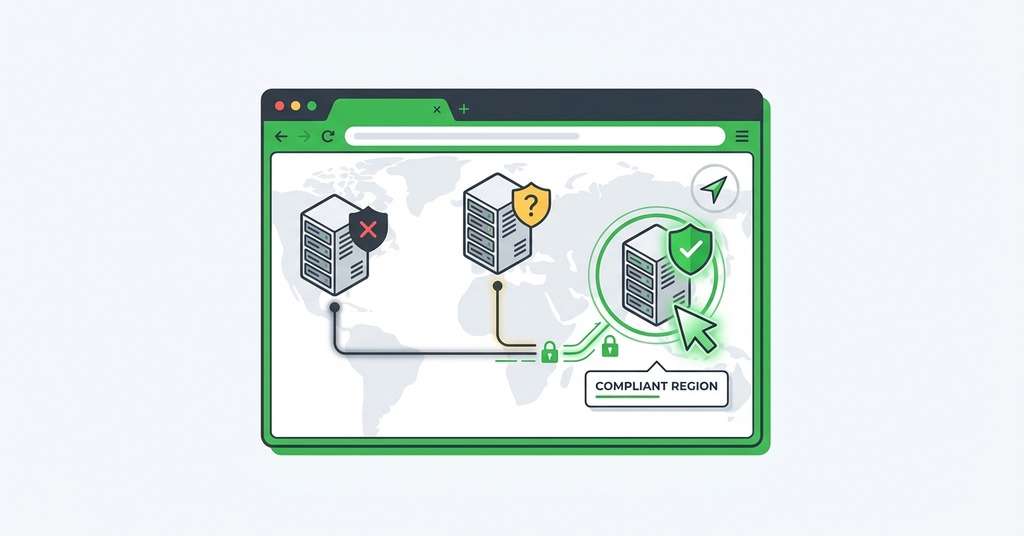
Start with speed, because latency is what visitors notice on every page load. Frankfurt’s exchange, the largest in the world by traffic, puts central European visitors 8 to 15 milliseconds from a well-connected server, against 80 to 90 milliseconds across the Atlantic to New York. The legal work follows the region choice and rarely changes it.
Check the cache and log regions of any bundled CDN before finalizing the choice. That includes the free Cloudflare integration hosts such as GreenGeeks put on their plans, which replicates content across borders without any further decision from the site owner.
GreenGeeks operates data centers in Amsterdam and Montreal alongside Chicago and Singapore. Amsterdam is the EEA option on that list, and Montreal is the adequacy option.
For an EU audience the EEA region is the straightforward path. For a mixed or North American audience an adequacy country or a certified US host does the same job with one extra document in the folder. The step people skip comes after the region is chosen. List every processor that will touch the data, including the backup target, the CDN, the analytics tool and the support tooling, then confirm each has a signed agreement before the first visitor arrives.
Frequently Asked Questions
What Is Data Residency?
Data residency is the physical location where data is stored and processed. Picking a hosting region is a contractual choice rather than a legal category. Data sovereignty is the separate question of whose laws govern the data. Data localization is a separate mandate to keep data inside a given country.
What Is the Difference Between Data Residency and Data Sovereignty?
Residency asks where the data is stored. Sovereignty asks whose law controls it. Data held in an EU data center run by a US-incorporated provider has residency without full sovereignty, because the US CLOUD Act still reaches it. FISA Section 702 is the second route by which US authorities reach the data.
Does GDPR Apply to US Websites?
Yes, when the US site offers goods or services to people in the EU or monitors EU visitors through cookies or analytics. A site merely reachable from the EU, with no targeting indicators, is arguably out of scope.
Does GDPR Apply to Small Businesses?
There is no general small-business exemption. The single carve-out, Article 30(5), relieves organizations under 250 employees of some record-keeping duties.
Does GDPR Apply to EU Citizens Living in the US?
Generally no. Protection attaches to where a person is at the moment of processing. Citizenship does not enter the test. A US tourist in Paris is covered while an EU citizen in New York is not.
What Is the EU-US Data Privacy Framework?
It is the adequacy decision adopted on July 10, 2023, permitting transfers to self-certified US companies. It replaced the Privacy Shield that Schrems II invalidated in 2020 and faces ongoing legal challenges. Most organizations relying on it keep executed Standard Contractual Clauses ready in case it falls.
What Is a Transfer Impact Assessment?
A Transfer Impact Assessment is the case-by-case analysis required when a site relies on Standard Contractual Clauses after Schrems II. It examines whether the destination country’s surveillance laws would let the importer honor the contract.
Do I Need a Data Processing Agreement with My Web Host?
If the host processes personal data for the site, yes. GDPR Article 28 requires a written contract covering instructions and security measures. Most established hosts publish a standard DPA the customer countersigns.
What Is the US CLOUD Act and Why Does It Matter for Hosting?
The CLOUD Act of 2018 lets US authorities compel US-incorporated companies to hand over data they control, wherever the servers are. It grew out of a 2013 warrant dispute over emails Microsoft stored in Ireland.
Do Backups Count for Data Residency?
Yes. Backups replicated outside the EU move personal data across borders. CDN edge caches and log pipelines do the same. Erasure requests apply to backup rotation schedules, with no exemption for copies held there.
What Happens If My Website Is Not GDPR Compliant?
Maximum fines reach 20 million euros or 4% of global annual turnover. Small sites more commonly see warning letters and orders to fix practices, plus deals lost when a customer’s legal team asks for a Data Processing Agreement the site cannot produce.
