
A freelancer with 3 client sites is already doing hosting support. Clients call the person who built the site when email stops arriving. They also miss renewal notices from a host they barely remember choosing.
Reseller hosting changes who gets paid for that work. The price argument that usually frames the decision is wrong. On 2026 renewal rates the third client is already the point where separate accounts cost more than a reseller plan holding 25 accounts.
For 3 clients the answer is still no. The client holds the contract, and the freelancer holds nothing but access to it.

| Topic | Key Point |
| What WHM adds | One interface that creates isolated cPanel accounts |
| Price crossover | The third client on renewal rates, the second against a cheaper plan |
| One shared account | Cheapest on the invoice, unsafe technically, forbidden in most terms of service |
| What moves the threshold | How the freelancer already works with clients |
| Under 5 clients | Separate client-owned accounts, with the client holding the contract |
| 5 to 15 clients | A reseller plan, bought for operations |
| Past 25 clients | The plan runs out of accounts, and contention decides the move to a VPS |
| Agency plans | Priced per install, bought for the platform |
| Handing a site back | Routine from a reseller account, manual from a shared one |
| The closing question | Revenue per site against cost per site |
What WHM Adds to a cPanel Account
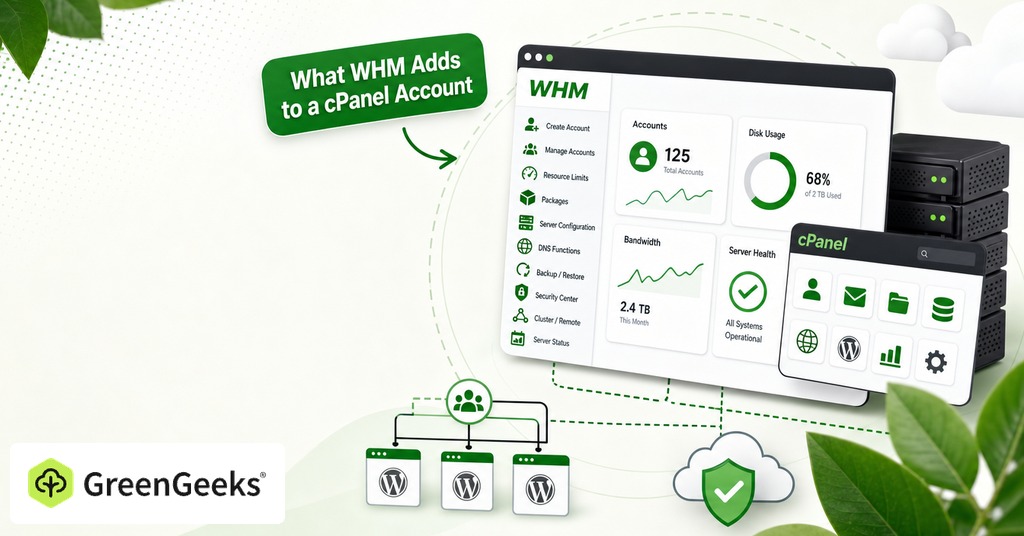
Everything a buyer is told about reseller hosting comes out of one interface. A reseller plan puts a limited version of WHM on top of a single cPanel account, and a reseller buys system resources from a hosting provider before allocating them to the accounts it sells. The operations that interface covers are a short list.
Creating and removing cPanel accounts.
Building reusable packages that set per-client quotas for disk, bandwidth, addon domains, databases and email.
Suspending one account without touching the others.
Assigning private nameservers under the reseller’s own domain.
Transferring accounts between servers.
A client can be handed a login because there is a second cPanel account to put them in. Per-client isolation exists because each account is a separate Linux user with its own home directory and databases, and branding and private nameservers follow from the accounts being the reseller’s to name.
cPanel does not test or support nested resellers, so do not build one. The other setting to know about is All Features under Root Access. It overrides account creation limits entirely and lets the holder open every account on the server. An upstream host should not hand that setting to a reseller.
The Price Crossover at Three Clients
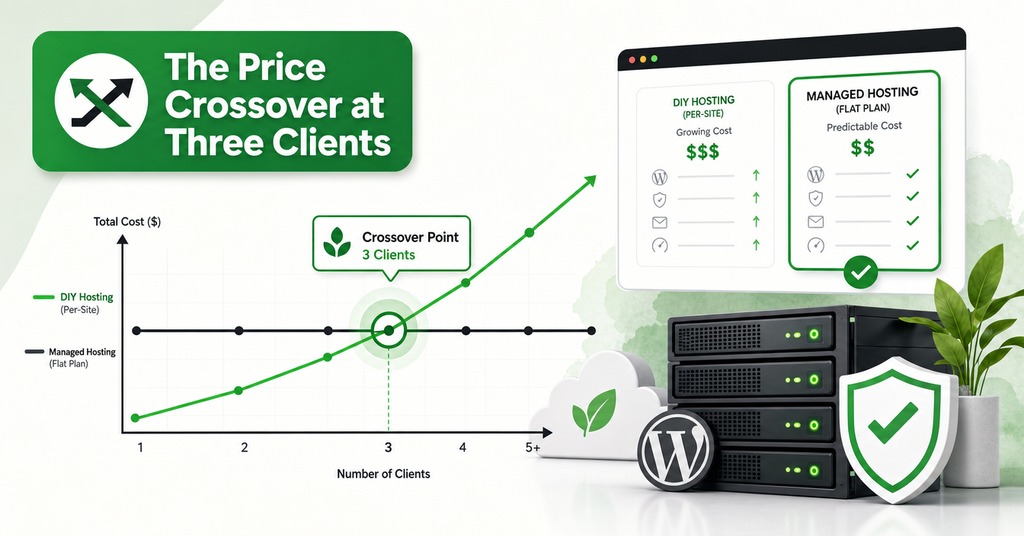
The 20-client break-even repeated across most hosting guides does not survive the 2026 renewal rates. Since promotional pricing is a first-year discount, the comparison has to be made at renewal.
| Arrangement | Renewal price | 3 clients | 5 clients | 10 clients |
| Separate entry shared accounts | $13.95 each | $41.85 | $69.75 | $139.50 |
| Reseller plan with 25 accounts | $34.95 flat | $34.95 | $34.95 | $34.95 |
Those are GreenGeeks’ published 2026 figures, and the crossover is the third client. Namecheap’s 25-account tier at $19.88 moves it one client earlier, with 2 entry accounts at renewal already above that price.
A freelancer in year one is looking at different numbers, and they hold for less time than the guides imply. At $2.95 a month per promotional entry account against $19.95 for a promotional reseller plan, separate accounts stay cheaper through 6 clients and lose at 7. After year one the discount is gone on both sides.
Can You Host Client Sites on a Regular Shared Account?
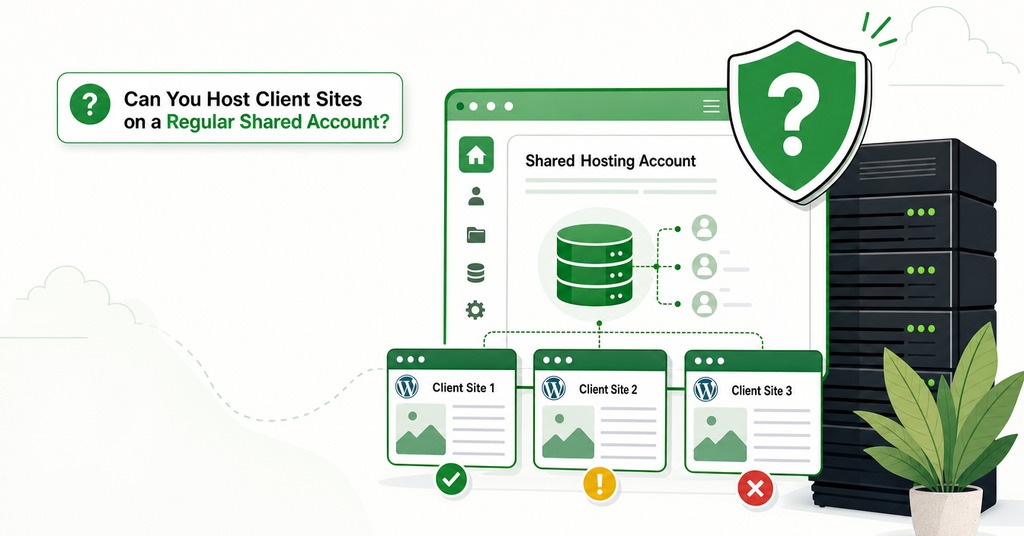
Buying one unlimited-websites plan and adding each client’s domain as an addon domain keeps the monthly bill flat no matter how many sites are on it. On the invoice it beats every other option at every client count. The contract rules it out before the security model does.
Addon Domains Run as One Linux User
By default every website in one cPanel account, along with the PHP process serving it, is owned by the same user and group as the primary site in public_html. Files from one site can read and write the files of another, so malware in one site reaches every site in the account.
Attention across a freelancer’s portfolio is uneven, which puts it close to the worst case. One or two sites get the plugin updates and the rest do not, and a single missed update or one compromised administrator account is enough to put every site in the account onto a blocklist. Balada Injector looks as far up the directory structure as it can to find other sites to infect. SocGholish injects itself into any JavaScript file it has write access to.
The resource limits are shared the same way, with the disk quota and the CPU limits covering every client at once. One runaway plugin therefore degrades every site, and no single account can be suspended on its own.
Terms of Service Rules on Reselling Shared Hosting
The contract usually closes the option before the security argument matters. GreenGeeks’ terms state that shared hosting account holders may not act as a reseller, that clients may not host websites in their addon domains that are not owned by the account holder on record, and that reselling requires opting into the reseller product, and most hosts write the same clause. The UK host 20i forbids customers to resell or offer any part of its hosting services to third parties unless a reseller product has been purchased. Any third party given access has to be monitored by the customer.
None of that depends on how well one Linux user separates client files from each other. A shared account holding client sites is already outside what the plan permits. The plan terms rule it out before the isolation problem is argued.
What Moves the Reseller Threshold
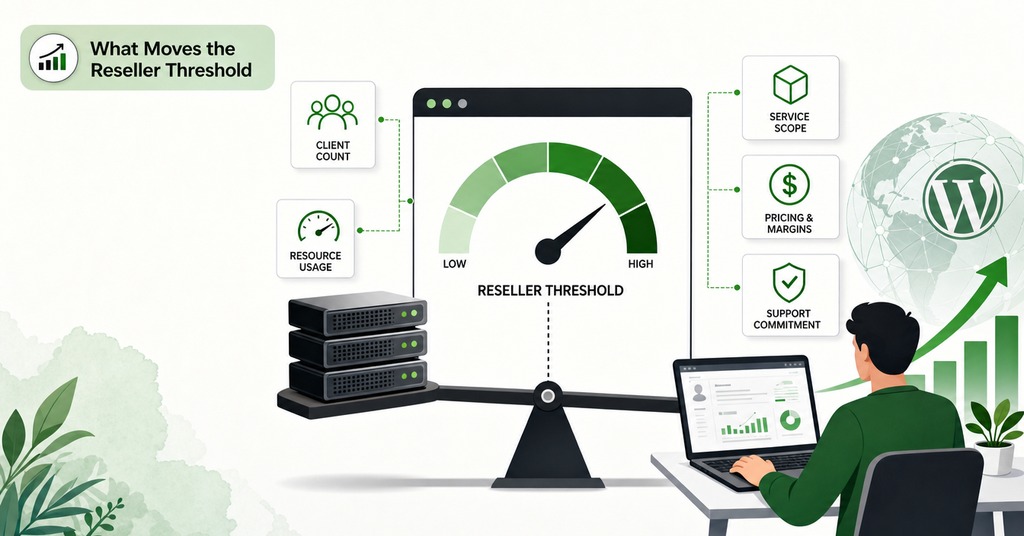
No threshold here applies to everybody, and the point moves with how a freelancer already works with clients.
Do You Already Answer the Hosting Questions?
Clients who bought their own hosting still call the person who built the site when it breaks. The freelancer in the middle does that work without a line on any invoice for it.
A reseller plan creates a support desk that did not previously exist wherever clients call their own host first.
Is Email in Scope?
A site can be rebuilt from a copy, while a mailbox that stopped syncing on a phone at nine at night leaves someone unable to work and produces the after-hours calls.
Backup retention makes that worse. A 24-hour platform copy is common on shared and reseller plans, and the terms behind it usually say the copy exists for disaster recovery and that keeping archives is the customer’s responsibility, so running your own WordPress backups becomes part of the paid work. A failure reported on Thursday that began on Monday is already outside a 24-hour copy.
Do You Want to Be the Merchant of Record?
Billing a client for hosting means becoming the merchant of record for it, with the dunning, refunds, chargebacks and tax that follow, and the billing software has its own monthly cost. WHMCS managed starts at $9.99 a month for up to 25 clients and its self-hosted tier starts at $34.95, the same monthly figure as a 25-account reseller plan at renewal. Card processing takes 2.9% plus 30 cents a transaction. At small ticket sizes the fixed 30 cents costs the most, 4.9% of a $15 invoice and 5.9% of a $10 one.
Small resellers bill annually for that reason, and a mid-term price increase from the upstream host then leaves them already paid at the old rate for the rest of the year.
Are the Domains Yours or Your Clients’?
If the sites are the freelancer’s own projects, the single shared account with addon domains is legitimate and cheap, and isolation is the only remaining problem. Client-owned domains put the arrangement outside what a shared plan permits.
Do You Need Reseller Hosting for 3 Clients?
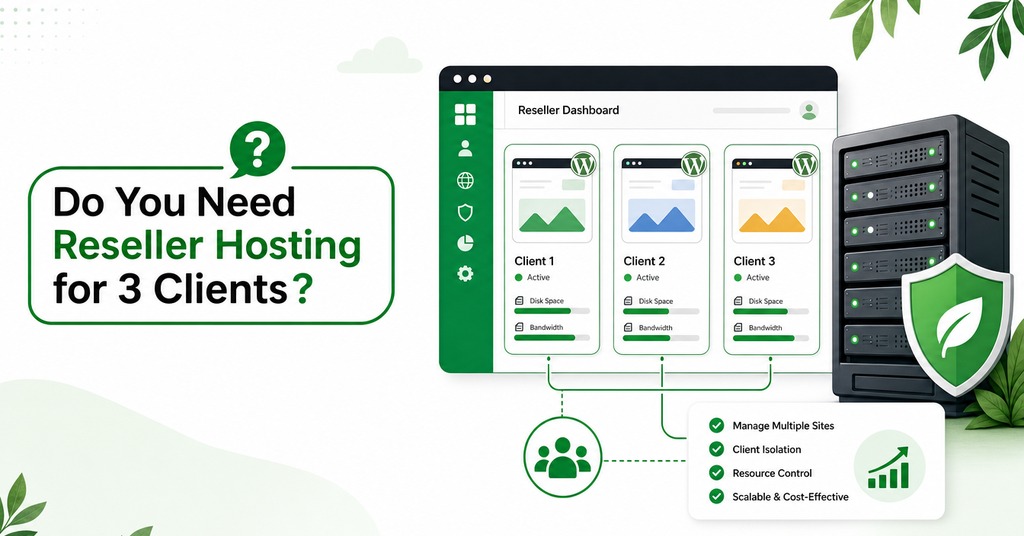
No. On separate accounts each client owns the account and pays for it directly, so the exit costs nothing. When the relationship ends the freelancer removes their access.
Billing software costs more at 3 clients than the hosting margin returns, and the support desk being formally taken on is 3 people whose questions were being answered anyway. Separate accounts on separate plans cannot contaminate each other.
The arrangement has one real weakness, and it is renewals. A client who misses a notice from a host they chose two years ago loses the site, and rebuilding it falls to the freelancer. Freelancers close that gap without a reseller plan in two ways, either by holding the account in the client’s name with their own address as the technical contact, or by selling a yearly maintenance line that includes checking the hosting is paid. Both stop working at about the point where remembering 5 renewal dates becomes its own job.
Reseller Hosting at 5 to 15 Client Sites
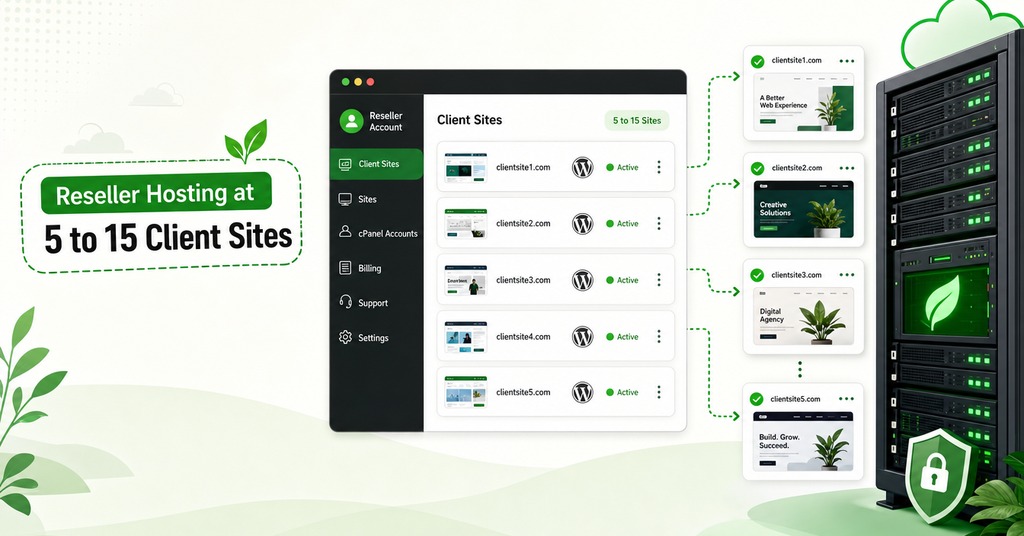
At this count the support burden already exists and isolation matters once the portfolio is big enough to have a forgotten site in it, so the plan pays for itself on operations. Per-client cost is $6.99 at 5 clients. At 10 clients it is $3.50 on a 25-account plan at renewal.
Who Supports Your Clients as a Reseller
Reseller contracts leave the upstream host supporting only the reseller, so broken mailboxes and slow-site reports arrive at the freelancer first and are escalated from there.
Setting Prices Without Underpricing
Most resellers underprice, with gross margins running 40% to 70% and hosting-only resellers nearer 40% to 50%, and neither figure counts the reseller’s own time. At a $15 monthly hosting line, 5 clients produce $75 against $34.95 of plan cost and about $3.68 of card fees, leaving roughly $36 a month before the reseller’s own time. The plan price stays at $34.95 whatever the client count, so the margin grows with every account added, reaching about $322 at 25 clients.
The hosting line is also the smallest part of what a client site costs to keep alive. A managed WordPress site typically costs $15 for hosting and $10 each for security tools and premium plugins. Support and maintenance add $25 and billing overhead $5, for $65 a month. Support and admin are roughly 45% of that and hosting is under a quarter.
Moving From a Reseller Plan to a VPS Past 25 Clients

Above 25 client sites a 25-account plan runs out of accounts, and the choice is between a bigger reseller plan and a server of the reseller’s own. On price the larger reseller plans stay cheaper. A 50-account plan renews at $49.95 and an 80-account plan at $69.95, or $1.00 and $0.87 per site.
The self-managed alternative is priced by its control panel license, and the machine underneath costs less than the license on top of it. cPanel license pricing works per account tier. Cost changes only at each tier boundary, and the reseller’s own WHM account counts against the limit, so client 5 moves the account from the 5-account tier at $35.99 to the 30-account tier at $53.99, an $18 jump for one client, and client 30 moves it to the 100-account tier at $69.99.
A 4 GB DigitalOcean droplet is $24 a month, so 25 accounts on a droplet with the 30-account cPanel tier come to $77.99 against $34.95 on a reseller plan. Dropping cPanel for DirectAdmin at $15 a month for 10 accounts, or $29 for unlimited, brings the server route to $53, still above the reseller plan.
The pressure that moves a reseller onto a server of their own comes from contention rather than from price. Clients on a shared reseller plan draw CPU and memory alongside other resellers’ clients on the same machine, and a reseller account cannot install a service, add a PHP extension or hand anyone root. At the point where one client needs any of those, the reseller account cannot provide it.
Hosts raising reseller prices every year are usually passing that same license cost through. One operator with 5 clients watched his plan move from $17.95 in April 2024 to $21.95, then to $24.95 in early 2025, while he was collecting from his own clients annually.
Until the isolation is configured on a VPS, every site is owned by the web server user, reproducing the shared-account contamination problem exactly.
Agency Plans Compared With Reseller Hosting
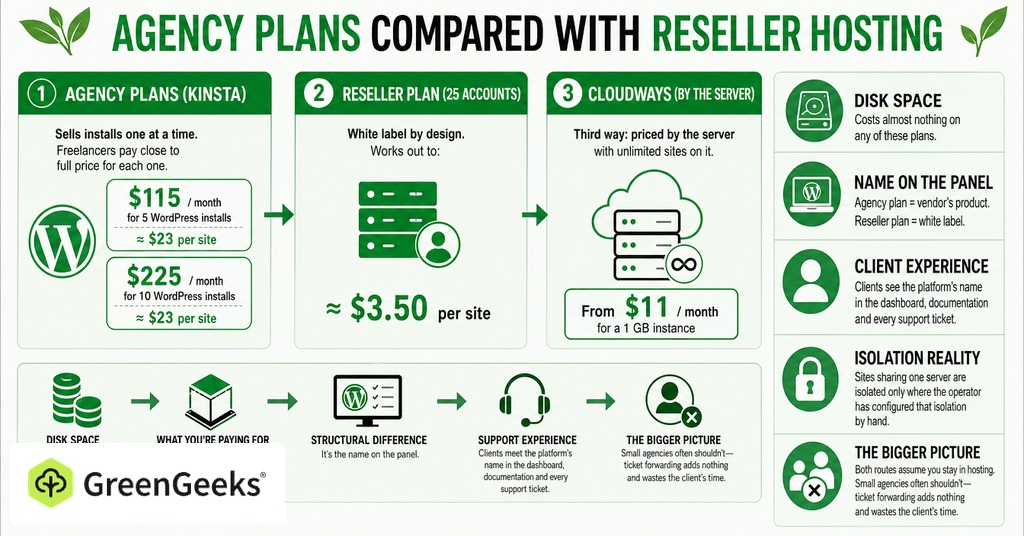
An agency plan sells installs one at a time, so a freelancer adding clients to it pays close to full price for each one. Kinsta charges $115 a month for 5 WordPress installs and $225 for 10, about $23 per site at either size, where a 25-account reseller plan works out at $3.50.
Disk space costs almost nothing on any of these plans, so the agency price buys the platform, the staging environments and the support. The structural difference is the name on the panel. A reseller plan is white label by design, where an agency plan is the vendor’s product with the reseller’s clients on it. The client meets the platform’s name in the dashboard, in the documentation and every time a support ticket is opened.
Cloudways prices a third way, by the server, from $11 a month for a 1 GB instance with unlimited sites on it. The economics look like a reseller plan until the isolation question arrives. Sites sharing one server are isolated only where the operator has configured that isolation by hand.
Both routes assume the freelancer plans on staying in hosting at all. Small agencies frequently decide they should not be, because an agency that only forwards tickets between the host and the client adds nothing and wastes the client’s time.
How to Hand a Client Site Back
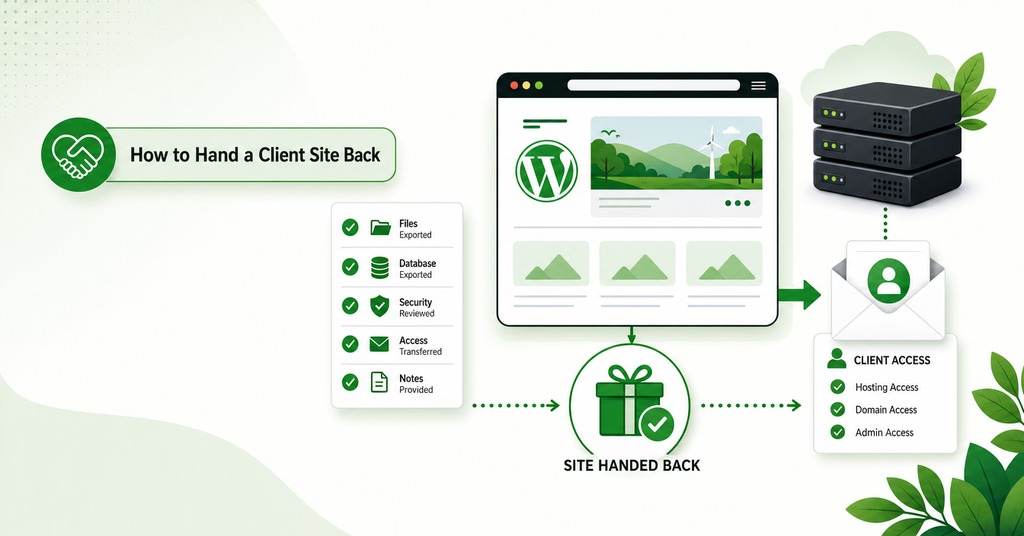
Across the three arrangements the cost of leaving differs by an order of magnitude, and that difference rarely appears in what a freelancer charges a client. Separate client-owned accounts cost nothing to leave, having never been the freelancer’s.
A reseller handover is a full cPanel backup. The site already has its own account and its own login, and that file is handed over or pushed straight to the new host.
The shared account with addon domains costs the most to leave. WHM has a Convert Addon Domain to Account tool, but a freelancer on a plain shared plan does not have WHM, and the tool has its own warnings anyway. The addon domain’s data stays on the source account after conversion, so the server needs roughly triple the space the new domain requires. Subdomains of the addon domain have to be deleted first or the conversion fails, and an assigned IPv6 address on the original account makes it fail outright.
Without WHM the route is by hand, starting with a download of the addon domain’s directory from public_html, then the etc and email directories one level up to preserve mailboxes, then a separate export of the databases, and finally a rebuild of all of it in the destination account. Doing this for 5 sites means 5 separate extractions, each with its own mailboxes to reconstruct, DNS to cut over and credentials to rewrite, because everything shared one Linux user and one database user. From a reseller account the same 5 handovers are 5 backup files.
Choosing Between Separate Accounts and a Reseller Plan
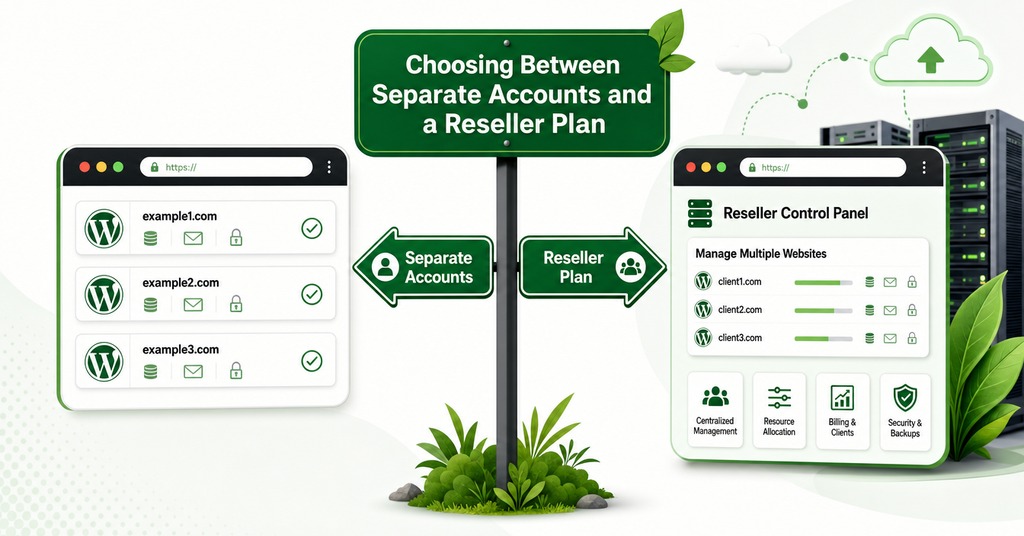
Fifty sites earning $1,000 a month on $200 of cost is a good arrangement, and 50 sites earning $300 might still be one if the list is growing. The client count matters less than revenue per site measured against cost per site.
A freelancer who took on two more clients and started handling their mailboxes has moved bands without changing anything about how the work is priced, so the review belongs on a yearly schedule, before something breaks and forces it. Waiting until 20 clients does not survive the arithmetic, with the crossover arriving at the third.
Frequently Asked Questions
What is reseller hosting?
A hosting plan that divides your server resources into separate cPanel accounts you can assign or sell to other people. A limited WHM interface above them creates, suspends and removes those accounts.
Is reseller hosting profitable?
Gross margins are real and your own time is not counted in them. Published ranges put most resellers at 40% to 70% gross. Ten accounts sold at $10 each on a $40 plan leaves $60 a month before support time.
Do I need WHMCS for reseller hosting?
Only if you are billing clients on a schedule. With 3 or 5 clients an invoice and a calendar reminder do the same job. WHMCS managed starts at $9.99 a month and Blesta at $17.95.
How much does a cPanel license cost in 2026?
cPanel prices per account tier. Solo is $29.99 a month for 1 account, Admin $35.99 for up to 5, Pro $53.99 for up to 30, and Premier $69.99 for up to 100. Annual billing saves 8.4%.
Why does my reseller plan keep going up in price?
cPanel bills the upstream host per account created on the server, and hosts pass that through. DirectAdmin is the usual escape, at $15 a month for 10 accounts.
Is reseller hosting white label?
Generally yes, covering anonymous servers, control panel branding and private nameservers under your own domain. Register your own nameservers from day one, because moving hosts later otherwise means asking every client to update theirs.
Can I see my clients’ files and email as a reseller?
Yes, and it cannot be turned off. WHM and cPanel are designed so that the administrator who creates an account can open it, including the client’s mailboxes, without needing their password.
Am I legally responsible for my clients’ websites as a reseller?
Under most reseller acceptable-use policies, yes. They make resellers responsible for their clients’ content and activity, which turns one client uploading infringing material into your account suspension.
Can my clients get their own cPanel login?
Only if each client has their own cPanel account, which means a reseller plan or a separate plan per client. Inside a single shared account there is one cPanel password, and the workarounds are per-client FTP users and webmail links.
Can I convert an addon domain into its own cPanel account?
Yes, using WHM’s Convert Addon Domain to Account tool, though it has conditions. Disk space has to be free for a full copy before the original is removed, subdomains have to go first, and an assigned IPv6 address blocks the conversion.
How much should I charge clients for hosting?
Price the whole stack, and treat the hosting line as one item inside it. A worked agency cost stack comes to $65 a month per site before margin, of which support and admin are about 45%.
Does reseller hosting include domain reselling?
Often yes, as a domain reseller account bundled with the plan. Domain margins are thin, so treat it as a convenience for clients.