
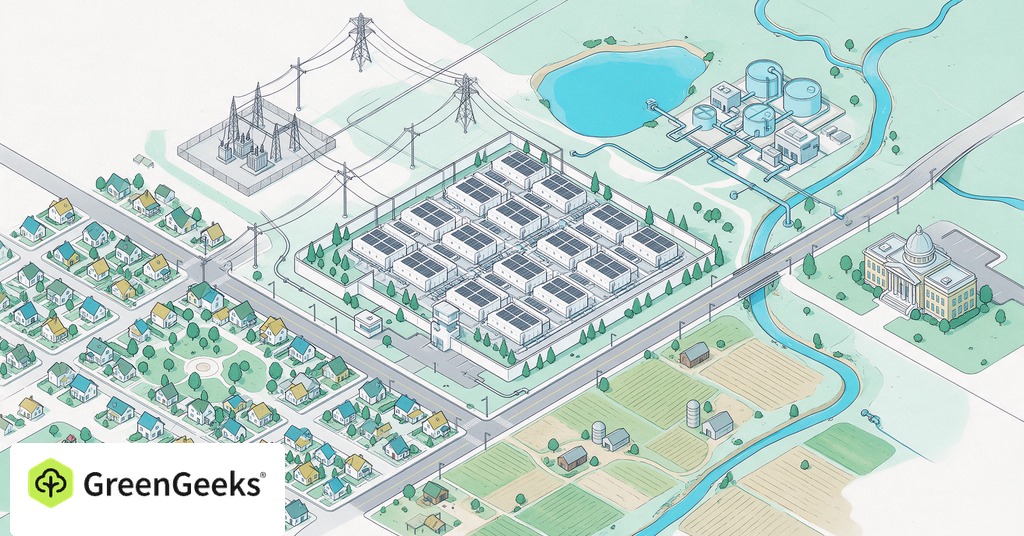
Nevada has put school taxes into the data-center bargain. Governor Joe Lombardo issued an executive order on September 18. It sets terms for developers seeking partial tax abatements. To bring that request before the state's economic development board, a developer must agree to pay the full Local School Support Tax and sign a binding Community Support Commitment.
The state is setting a price for a tax break. The grander arguments about AI can overlook who pays for its growth. A town weighing a data center has bills of its own.
Those bills deserve a place in the deal before the project gets public aid. Power lines, water supplies, land and tax revenue are matters for local debate. A project can be worth building and still call for a hard bargain. Its value becomes easier to believe when someone must keep each promise by a set date and face a cost for failing to do so.

Electricity costs last longer than construction
A data center can need new power lines and other grid upgrades that take years to plan and longer to pay off. The obvious question is whether enough electricity will be available. The question behind it is who pays if the project uses less than expected, arrives late or never opens.
The deal needs to account for that uncertainty. A forecast of future demand may justify an investment, but it cannot guarantee that the customer will pay for it.
The utility and developer should explain which upgrades the project needs, how they will be paid for and what happens if the customer leaves. A deposit, a minimum bill or some other pledge to cover the cost may be needed. The terms will depend on the utility and the agency that oversees it. A household should not have to pay for grid upgrades built for a large business whose plans changed.
Nevada's required commitment covers the cost of serving the site and safeguards for other ratepayers. It also covers grid emergencies and water standards. California's seven-bill package, signed September 21, also addresses who pays for power and the upgrades developers should fund. These states are getting more precise about the terms. The bills have been signed, but that does not mean every safeguard is already in force in every utility's service area.
Nor should a promise to buy clean power end the debate. The local utility still has to serve the load. Residents need to know what will be built and who will pay for it, as well as what the plant must do when the grid is under stress.
A serious developer can benefit from clear terms, too. They spell out the costs before a company spends heavily, while giving neighbors more than a promise that everything will work out.
Water and land are local decisions
A national debate about water can tell a town very little about its own supply. A volume that looks modest in one place may strain supplies in another. Its source matters. So do the time of year, the cooling design and the rules that take effect during a drought.
A plan should show how much water the site expects to draw, how much it will use up and what could change those amounts. Water returned to a system and water lost through evaporation are different quantities. Residents need both figures to judge the strain on their water supply.
California's new package calls for reports on water use and supply, how well water is used and plans for drought. It also changes parts of the environmental review process and which projects qualify for faster approval. Those reports could help residents judge a plan against local needs. Their value will depend on how the rules are put into practice.
Land use calls for another set of judgments. A large industrial site affects what can happen around it. Residents and local officials can reasonably ask about noise, backup equipment, access roads and nearby uses without first taking a stance on the future of AI. The plans should let them judge those effects before the land-use decision is settled.
The measurements should continue after approval. A baseline and reports made public on a set schedule would let residents compare the working plant with the plans approved for it. Where limits are needed, someone must check on complaints and enforce the rules. A dashboard helps only if it answers the questions that mattered when the project got permission to proceed.
Read the tax offer with the job promise
A data center can bring new spending, building work, long-term jobs and useful computing capacity. Those gains deserve to be weighed as seriously as the costs.
Oracle's September 8 announcement about Project Jupiter in Doña Ana County, New Mexico, makes that case. Executive Mahesh Thiagarajan says the project can bring investment and jobs while also protecting local land, water and air. Oracle projects 7,000 construction jobs and 1,500 ongoing project-supported jobs. Those forecasts depend on the air permit and pipeline being approved as planned.
Those are different kinds of jobs, and a local deal should treat them that way. Construction work can be valuable without lasting for the life of the facility. The company needs to say what it counts as an ongoing job and how that count can be checked. The two kinds of work should not be merged into one large number.
Oracle also promises public environmental data and independent assessments twice a year once the project is operating. Residents could ask what will be measured, who will check it and what will happen if the results show a problem.
The case for more capacity goes beyond one county's tax receipts. Canada's industry minister, Evan Solomon, has argued that more computing capacity at home gives researchers and businesses more choice and makes them less exposed to outside risks. That is a public interest worth taking seriously. A country that wants digital services also needs to consider where they will run.
But a national need does not settle whether a project is right for a given place. Tim Tierney, president of the Federation of Canadian Municipalities, has stressed that local leaders need all the facts because places and projects differ. Canada's principles for responsible development work alongside provincial, territorial, municipal and Indigenous approval processes. They do not override those processes.
The tax offer needs the same care as the job offer. The total tax bill tells only part of the story when tax breaks and public costs are involved. Officials should be able to explain what they expect to collect, what they are giving up and which estimates could prove wrong. A project that still looks worthwhile after that accounting has a stronger claim on public support.
Put the commitments in enforceable terms
Communities need to negotiate while they can still change the terms. Once roads have been changed, work on the grid has begun and a tax break has been granted, local leaders may have much less room to bargain.
The written deal should make clear which promises must be kept and which are hopes:
- Who pays for the needed upgrades?
- What water conditions apply during a shortage?
- Which job or spending promises support the tax break?
- What can be recovered if those promises are missed?
The agencies in charge of each part of the project should be able to answer.
One city official may lack the power to settle all of them. Utilities, regulators, water boards, schools and local government each have a role. They need to agree on who does what. A developer should be able to find a clear path through that process, and the public should be able to find out what each side has agreed to do.
The deal also needs to stay readable after the people who wrote it have moved on. A future school board member or ratepayer should not need to reconstruct a groundbreaking speech to discover what the company owes.
A data center can earn its place in a community. The agreement should make clear what earning that place will require, through construction and into the less ceremonial years when the facility is running and the bills keep arriving.