
A fair price for a small site is $5 to $15 per month at the renewal rate, with SSL and daily backups inside that figure. The prices that dominate hosting ads, $1.99 to $3.99 per month, buy a first term and nothing beyond it. Hostinger’s Premium plan advertises $1.99 per month and renews at $10.99. Check what a plan renews at before signing anything, since that regular rate is what the site costs every year after the first.
Why the Price on the Homepage Is Not the Real Price
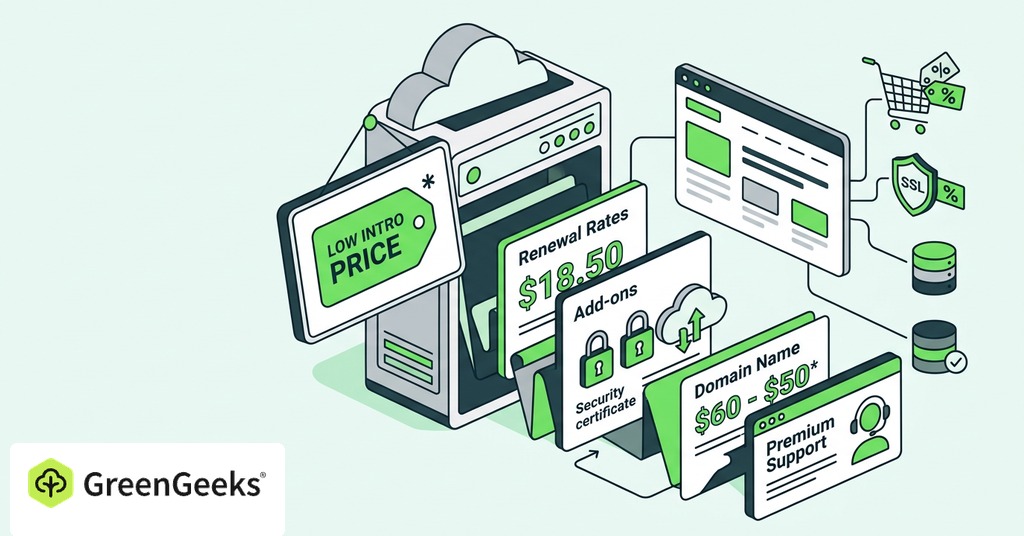
Shared hosting runs on loss-leader pricing, so the host breaks even or loses money on a first term and recovers the margin at renewal, banking on the fact that moving a website is enough friction to keep most people in place. Those advertised rates exist to acquire customers, and they are not meant to describe what hosting costs.
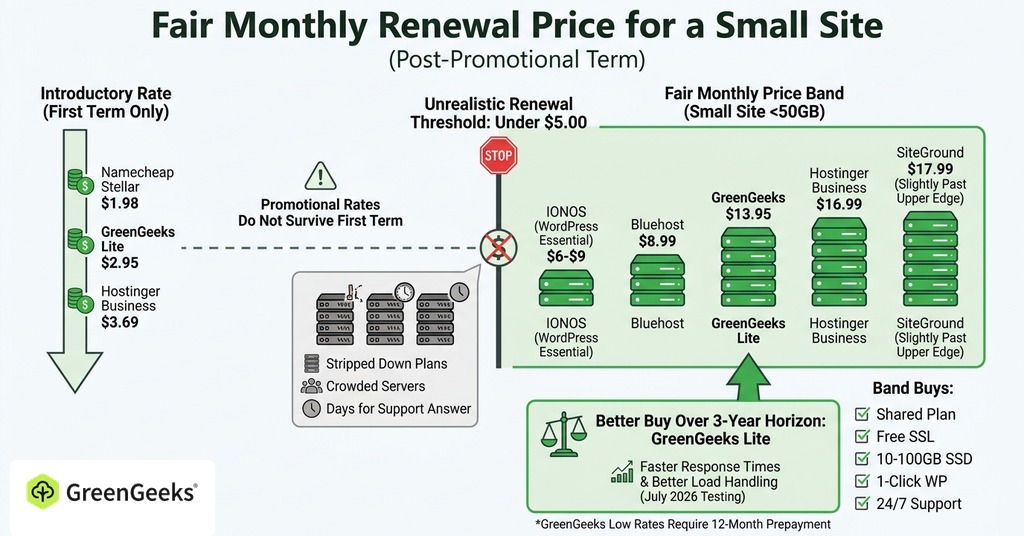
Buyers compare intro prices while the renewal multiple is what a plan costs. The size of the jump varies by host, though every host jumps upward. Hostinger’s Premium plan moves from $1.99 per month on a promotion to $10.99 at renewal, SiteGround’s StartUp from $2.99 to $17.99, and GreenGeeks’ Lite from $2.95 to $13.95. Across the budget tier the increase comes to between 200% and 450%, depending on which promotional rate a customer locked in. The lowest advertised rate also requires prepaying 36 to 48 months. Bluehost’s $1.99 figure means $95.52 leaves the account on day one. Monthly billing exists at most hosts. It is usually the most expensive way to pay, and HostGator’s Hatchling plan renews at $17.59 per month billed monthly against $10.99 per month on a three-year term.

Long-term customers leave over this even when they have no complaint about the service. A SiteGround StartUp account held through renewal pays six times what it did in the first year. Years of clean uptime do not offset that invoice. People who like their host treat the jump as a reason to migrate rather than a cost of staying.
What a Fair Monthly Price Looks Like for a Small Site
Why No Mainstream Host Renews Under $5
No mainstream host renews under $5. IONOS comes closest, renewing its WordPress Essential plan at $6 to $9 per month after a $1 first year, and Namecheap’s Stellar plan rises only modestly from its $1.98 intro rate without reaching below the line either. A renewal figure under $5 at any other major host usually means the promotional rate is still on screen and the real number appears on a later page of the checkout flow. The other possibility is that the price is real and the plan is stripped down. Pricing that low usually means crowded servers and support queues that answer in days.
The $5 to $15 Fair Band
A small site under 50 GB belongs in this band once the promotional term ends. Cheaper guidance circulates, putting a personal blog at $3 to $5 per month and a WordPress portfolio at $2 to $10, though those numbers quote introductory rates and do not survive the first term. What the band buys at a mainstream host in 2026 is a shared plan with a free SSL certificate, 10 to 100 GB of SSD storage depending on the provider, one-click WordPress installation and 24/7 support. Real plans fall across the whole width of it as of July 2026. GreenGeeks Lite renews at $13.95 and Bluehost at $8.99, with Hostinger Business at $16.99 and SiteGround at $17.99 slightly past the upper edge.
GreenGeeks Lite and Hostinger Business cost within a dollar of each other at the intro rate, $2.95 against $3.69, and $3 apart at renewal. In July 2026 testing the cheaper renewal also posted faster response times and better load handling. Over a three-year horizon GreenGeeks is the better buy on both counts. The example comes with one condition. GreenGeeks’ low rates require a 12-month prepayment and monthly billing adds a $15 setup fee. Reviewers also disagree on Lite’s storage allocation, citing 50 GB in one test and 25 GB in another, so the current figure needs checking before it is treated as fixed.
When $20 or More Is Overpaying
Above $20 per month, a single small site on shared hosting is paying too much unless the plan is managed WordPress hosting. A $15 to $35 monthly price makes sense for a small business site only when it pairs automatic updates and staging with a managed security layer and expert support. Without those features, $25 per month buys the same shared server resources that cost $12 at a competing host.
Ask what the extra money buys. If the answer is the brand name, or a larger figure attached to an “unlimited” promise, the money buys nothing.
What Should Be Included at a Fair Price

Two plans at the same renewal price can differ by hundreds of dollars a year once the bundle is opened. With free SSL now standard on every plan, the certificate no longer tells buyers anything. Backups and email are where plans diverge. Storage ceilings come close behind.
Daily backups come with every plan at DreamHost, SiteGround and GreenGeeks. Hostinger’s Premium tier backs up weekly only. Bluehost reserves daily backups for its higher tiers. On a site updated more than once a week, that can cost days of rebuilt work after a single failure.
Free email accounts come with GreenGeeks, SiteGround and Namecheap plans. Hostinger includes email for the first year and then bills about $1.59 per month per inbox, while Bluehost treats it as a paid add-on. Storage is the third point of difference. Bluehost dropped its unmetered tier in 2025. Its Basic plan now caps at 10 GB, enough for a text-led WordPress site and short of what an image library needs, against 100 GB from Hostinger at a similar intro price.
When hosts unbundle these features, a low advertised price can exceed a more expensive plan that includes them. Paid SSL and separate email hosting come back onto the bill one line at a time. Neither appears in the headline figure. The renewal price only means something once both lines have been added back into it.
How to Pay Less than the Posted Price

Retention teams at most budget hosts can approve a discount without escalation. The posted renewal rate applies mainly to customers who never ask. Calling 30 to 45 days before a renewal and naming a competitor’s current promotional rate commonly produces discounts of 40 to 60% on a plan whose price has doubled at renewal, or an extension of promotional pricing for two or three more years. More than 70% of customers simply pay whatever the renewal invoice says. Black Friday and Cyber Monday sales ran 70 to 90% off multi-year plans in late 2025, with SiteGround at 83% off managed WordPress and GreenGeeks at 75% off shared plans, and buying inside that window resets the effective price for years.
Longer prepayment lowers the monthly figure. It also raises the stakes of the renewal date. Pair any multi-year term with a calendar reminder set a month before it ends, and set that reminder the day you sign up.
The One Number to Check Before You Sign Up
Before checkout, find the plan’s regular rate on the host’s own pricing page or help documentation. HostGator publishes a full renewal chart. Most hosts have an equivalent page buried in their support section.
If the renewal figure is not published anywhere on the host’s own site, price the plan at double the intro rate before deciding.
Frequently Asked Questions

How Much Does Web Hosting Cost per Month?
Shared hosting costs $5 to $20 per month at regular rates, with introductory offers as low as $2 to $5. A VPS costs $20 to $90 per month, and dedicated servers begin at $70 and can pass $1,000.
How Much Should I Pay for Web Hosting for a Small Website?
Budget $3 to $5 per month at intro rates and $5 to $15 per month at renewal for a quality shared plan. Across three years the renewal band totals $180 to $540, which is the figure to compare between hosts.
Why Does Web Hosting Renewal Cost More than the First Year?
The intro price is a discounted acquisition rate covering a first term only. At renewal the plan reverts to the regular rate, which at budget hosts is typically two to five times higher.
Is $10 a Month Too Much for Web Hosting?
No. At $10 a single-site shared plan falls inside the normal renewal band, and mainstream renewals cluster between $9 and $18 per month. The price is fair when backups, SSL and real support are bundled into it.
Is Cheap Web Hosting Worth It?
Yes, from a reputable provider. Below about $2 per month, crowded servers and slow support cost more than the few dollars saved.
What Should Be Included in a Basic Hosting Plan?
At minimum, a free SSL certificate and 10 to 50 GB of SSD storage, plus one-click WordPress installation and 24/7 support. Daily backups and free email accounts come standard at some hosts and cost extra at others, so check both line items before comparing prices.
How Can I Lower My Web Hosting Costs?
Call the retention department 30 to 45 days before renewal and cite a competitor’s current promotional rate. Documented outcomes reach 40 to 60% off the renewed price. Buying during Black Friday sales, which ran 70 to 90% off multi-year plans in late 2025, resets the effective rate for years. A New Year sale window also exists, typically 60 to 75% off.
Can I Negotiate My Hosting Renewal Price?
Yes, provided you name a competitor’s current offer and are genuinely prepared to migrate if they decline.
Is It Cheaper to Pay for Hosting Annually or Monthly?
Annual billing is substantially cheaper. Month-to-month rates are usually the highest a host lists, and some hosts add a setup fee to monthly billing on top of the higher rate.
Does Hosting Include Email Accounts?
It depends on the host. GreenGeeks includes email free, as do SiteGround and Namecheap, while Hostinger charges about $1.59 per inbox per month after year one and Bluehost sells email as an add-on. Bought standalone, email hosting costs $1 to $15 per month.
Is Free Web Hosting a Good Idea?
It is almost never worth it for a site you care about. Free hosting places ads on your pages and imposes strict resource limits, with slow performance and no meaningful support.