
Six hours into a hosting failure, an owner may still be repeating the diagnosis while orders remain unrecovered. Owner time and outside repair now have direct costs, and several years of hosting savings can disappear in one interruption.
Price that incident before comparing plans.
Use a failure the current site has experienced or one documented in its recovery plan, then compare the estimate with the annual premium for a provider that can shorten recovery. Site risk and the owner’s ability to restore service set the value of that response path.

The Case for Choosing the Lower Price

Low-cost hosting is a rational choice when the site has limited business consequences. A hobby site or temporary campaign can tolerate a longer interruption. A simple brochure may have the same tolerance. Savings can go toward the backup and exit resources that keep this risk controlled.
An owner who can read logs and restore a backup needs less diagnostic help from the host. Independent backups reduce dependence on the provider’s restore process.
Current site files and database exports stored outside the hosting account give the owner an independent restore source. Keeping the domain in an accessible registrar account also permits a DNS change during a hosting failure.
Compare the full renewal cost before declaring one plan cheaper. Add paid backup service and email if the plan excludes them. A long billing commitment has value only when the owner accepts the switching cost.
Recovery that depends on unavailable support exposes the buyer to emergency developer work and missed appointments. A $60 annual saving disappears with one modest repair bill.
For this buyer, price is a controlled risk because the site owner has already funded the backup and exit process needed when provider recovery is slow.
The Case for Paying for Support

Support quality has value when the provider can shorten diagnosis and recovery. A skilled agent can inspect platform evidence unavailable to the customer and identify an infrastructure fault. The agent can also send the issue to the correct server team.
Agent authority controls what happens after contact. A provider can answer chat at any hour yet require a ticket before a server team can investigate the issue that stopped the site.
Resolution time runs from the initial request through diagnosis and corrective action. It ends after verification that the service works. A 2-minute greeting does not shorten that interval by itself.
The plan’s written support boundary and escalation route provide evidence of service value. Price alone cannot show the first agent’s skill or the server team’s access. Test the documented route before assigning a dollar value to it.
Support earns a premium when it supplies recovery capacity the owner lacks. The annual price difference should buy a response path suited to the site’s likely failures.
Delayed evidence requests extend resolution time. If an agent requests one log and asks for the failure timestamp in a later reply, the customer waits through another queue period.
Good triage collects the required account details in the first exchange and identifies the responsible service layer. A pre-sales test can reveal if the provider documents this process.
Price One Plausible Hosting Incident

Use the following incident estimate for every finalist.
- Multiply the owner’s ticket-management hours by the value of displaced work.
- Add a normal emergency developer rate for application work the host excludes.
- Add only the observed leads or transactions that cannot be recovered after service returns.
Use the same annual period for every provider so monthly prices and one-time repair costs remain comparable.
Consider an illustrative service business that saves $120 per year on hosting. During one failure, the owner spends 3 hours managing tickets at an assigned value of $50 per hour. A developer bills 1 hour at $150. The direct recovery cost is $300 before any missed leads, so the annual saving does not cover that incident.
A site with no interrupted business process produces a small incident estimate when the owner can restore it quickly. Under those recorded conditions, a $120 annual support premium may have little economic value. Keep the assumptions with the decision because site use can change.
Uptime credits belong outside the incident-cost estimate. A credit usually reflects a portion of the hosting fee, while the business absorbs its own labor and lost activity. Read the measurement window and exclusions before treating the guarantee as recovery protection. A monthly 99.9% target allows about 43.8 minutes of unavailability in an average 30.42-day month, yet the agreement may exclude customer code or outside network failures.
Test Support Before You Buy

Give every finalist the same plan-specific test. Score the response on the common criteria below.
- Responsible team and required channel
- Time to the first useful answer
- Written support boundary and exclusions
- Escalation route with a durable case record
- Access to files, database exports, domain transfer, and email export
A backup-restore question makes the test concrete. Ask who performs the restore on the proposed plan. If the agent says custom code remains the customer’s responsibility, request the documentation that states the boundary. Then ask which channel can involve a system administrator when the restore itself fails. Save the exchange and its timestamp. Accuracy about a limitation is useful because it tells the owner to arrange developer coverage before an incident.
Run the test in the channel the provider documents for complex problems. Automated acknowledgments do not count as a useful answer. Exit access belongs on the same score sheet because a plan becomes expensive when leaving requires the buyer to rebuild data.
GreenGeeks Support as a Scope Example
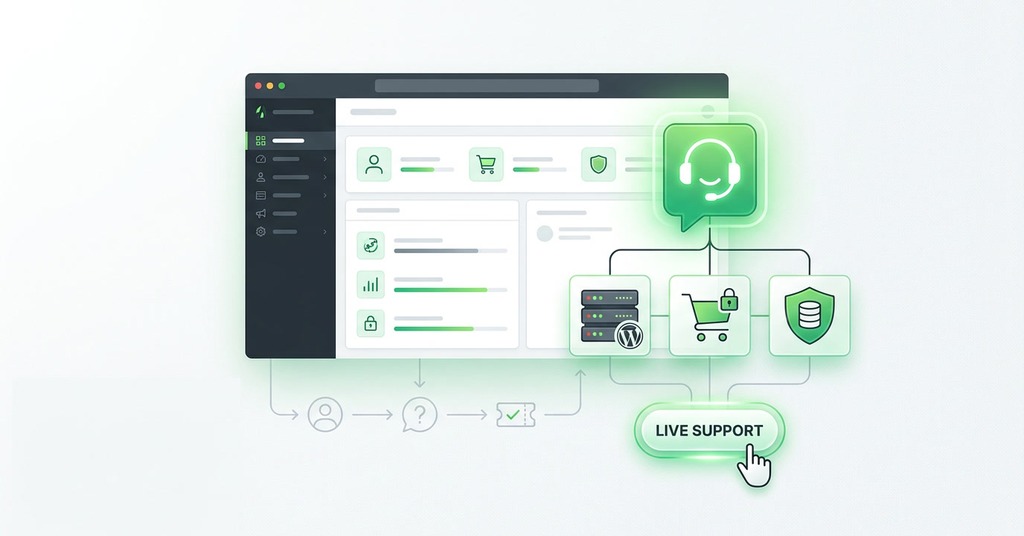
GreenGeeks provides 24/7 support access. Its published details map the available channels to likely work.
- Live chat and phone provide entry points for immediate account or hosting questions.
- Tickets create a documented route for longer issues and VPS matters. Management escalations also use tickets.
- Daily backups can reduce routine recovery work when the requested restore falls within support scope.
- Support-handled migration reduces transfer work for an eligible move.
The route matters because the first contact may need to move the case to a team with server access. Starting a VPS issue by ticket creates the record used for that assignment.
Third-party development can fall outside the provider’s responsibility. A WordPress plugin fault may require a developer even when the server operates as designed. Site owners need an outside contact for application work.
Published guidance says management escalations commonly need 24 to 48 hours. The buyer’s observed loss per hour converts that period into business exposure. A site with no lost activity during the wait records zero on that line of the incident estimate.
Channel choice affects the time required to assign the issue to the responsible team. Chat can confirm account status and basic service availability within one exchange. A ticket preserves attachments and timestamps. Phone support may help with immediate account questions.
The customer should begin in the documented channel for the fault, then keep the evidence in one case record. Repeating the full diagnosis in several channels can slow assignment.
Service credits reimburse a defined portion of the hosting charge under stated conditions. Lost sales and internal labor remain with the customer. Keep the recovery plan funded independently of that contract remedy.
Choose by Failure Tolerance
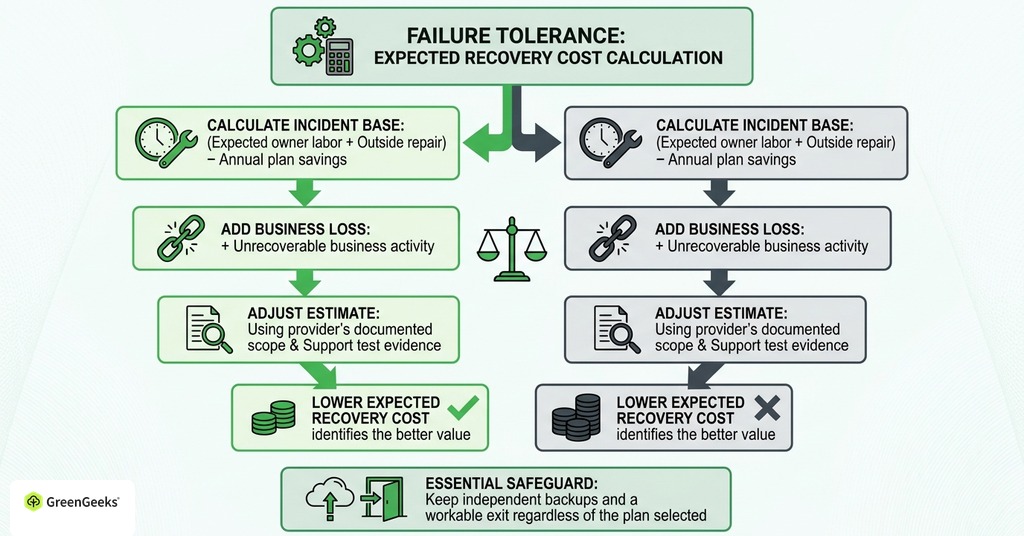
Return to the incident calculation after testing each provider. Subtract the annual plan savings from the expected owner labor and outside repair. Add unrecoverable business activity as its own line. Then adjust the estimate using the provider’s documented scope and the evidence from the support test. The lower expected recovery cost identifies the better value. Keep independent backups and a workable exit regardless of the plan selected.